Human Friendly Robotics announced on 6 October a three-year robotic tiling contract worth up to $4 million with Flooring Concepts of NJ, a commercial flooring subcontractor. The robots will work alongside Flooring Concepts’ installers across New York, New Jersey, Pennsylvania and the greater New York City metropolitan area, according to the company’s announcement, which carries a Morganville, New Jersey dateline.
Construction robotics generates a great deal of news that is not quite this. Funding rounds, pilots, partnerships, a video of a machine doing something impressive on a floor nobody has to pay for — the category is thick with announcements in which no customer has publicly committed anything. What makes this one worth reading is that a subcontractor has put a share of its actual production behind the machine, and the release says how the money changes hands.
The Share of Work, Not the Unit Count
The release puts a number on the commitment: “The installation capacity purchased represents at least 15%-40% of Flooring Concepts’ LVT tiling work over the next three years.” LVT is luxury vinyl tile, one of the materials the robot handles.
That framing is unusual and worth dwelling on. Robotics announcements normally count machines — units shipped, units deployed, units ordered. This one counts a percentage of a trade contractor’s workload in a named material over a named period. A range of 15 to 40 percent is wide, and the release does not break it down further or say what moves a job from the bottom of that range to the top. But as a disclosure it is harder to inflate than a unit number, because it is denominated in work the subcontractor has to win and schedule either way.
Flooring Concepts is led by President John Pilot. The release says the company “reports that its pipeline already includes significant work scheduled for 2028” — which is the condition that makes a capacity deal legible. A subcontractor already scheduling work into 2028 is not an obvious candidate for cutting headcount; on the account both parties give, the constraint is that the work exceeds what its crews can physically lay.
The Sentence That Explains the Deal
The most informative quote in the release is not about the technology.
“Growing our business starts with supporting our people,” said Pilot. “Tyler will help us expand capacity, improve scheduling and reduce some of the hardest physical demands on our crews. Thankfully, I can just pay per square foot of install instead of purchasing the equipment. It’s an investment in our workforce and our customers without undue capital expenditures.”
That second half is the commercial model stated by the customer rather than the vendor: Flooring Concepts is not buying a robot. It is buying installed square footage, priced the way it already prices labour, with the capital cost and presumably the maintenance and downtime risk staying with Human Friendly Robotics.
This matters more than it sounds, and the reading that follows is this publication’s own. The reason construction robotics has been slow to land is rarely that the machine cannot do the task. It is that a specialty contractor running on thin margins is being asked to take a capital position in a technology it cannot service, on jobs where a non-functioning machine means a missed schedule and a back-charge. Pricing the output instead of the asset moves that risk to the party that can actually fix the robot — and makes the purchase an operating line rather than a board decision. It also means the vendor’s revenue scales with square footage laid, which is a harder business to run and a much better one to underwrite, because the customer only pays when the thing works.
The company’s own site lists a target for that price: “$1.50 our target, per sq ft”, against “$4–$8 a crew’s, per sq ft”. The word target is Human Friendly Robotics’ own; the release does not disclose what Flooring Concepts is actually paying, and neither does the site.
What the Robot Is Claimed to Do
The machine is called Tyler. Human Friendly Robotics’ spec page for it describes a 50-pound chassis that “rolls onto a commercial jobsite, scans the floor, and installs tile, vinyl, or carpet at about 100 sq ft an hour — with one operator, where a hand crew struggles to staff the job at all.” The listed performance figures are a placement rate of roughly 100 square feet per hour, precision of ±1 mm, a 50-pound weight, materials covering tile, LVT, carpet and VCT, and a crew of one operator on site.
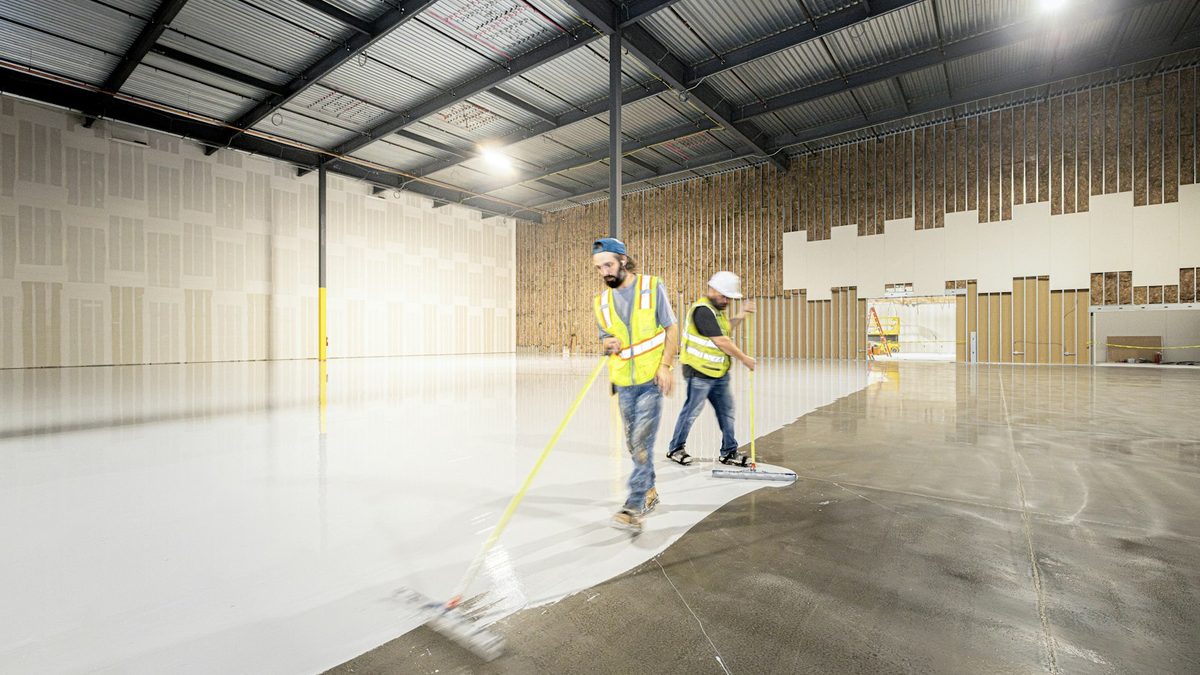
The division of labour is specific, and both the release and the site describe it the same way: the robot does repetitive placement, and the installers keep cuts, edges, finishing and quality control. The release adds that “With training, tile setters can operate Tyler without a robotics background.”
On throughput, the company’s own page is more careful than most vendor material, and the caveat deserves to be reproduced rather than summarised. The site compares a day’s work by hand against a day with the robot — roughly 100 square feet by hand against roughly 800 with Tyler for mortar-set ceramic, and roughly 750 against roughly 1,500 for glue-down LVT — and then says: “Manual rates from contractor figures; Tyler’s daily output is a full-shift projection of its ~100 sq ft/hr placement rate. The multiple varies with crew, material, and job mix.”
That is the company labelling its own headline multiple as a projection from a measured hourly rate, which is a distinction most vendors leave to the reader. The “8X faster” in chief executive Shamoon Siddiqui’s quote in the release matches the ceramic row on that page — roughly 100 square feet by hand against roughly 800 with Tyler — though the release itself does not say which material the multiple refers to. It is the company’s figure either way, and the company’s page says what its own version is derived from.
“Tyler multiplies a tile setter’s efficiency and output,” said Shamoon Siddiqui, CEO of Human Friendly Robotics. “Our customers have more work than their crews can fulfill. We give skilled professionals a tool to complete their work 8X faster, and without tiring. Ultimately, we’re reducing physical strain and helping tile setters build longer careers in the trade.”
One claim in the release this piece does not verify: it states that “A contract of this size for robotically installed flooring is a milestone first.” That is the company’s characterisation. Contract values in specialty trade subcontracting are mostly private, so the comparison set is not public, and nothing here should be read as confirming it.
The Labour Argument, and Who Is Making It
The release grounds the deal in workforce data rather than in autonomy, citing a September 2026 survey from the Associated General Contractors of America and NCCER. That survey is real and the figure checks out: AGC’s 3 September write-up reports that “Forty-two percent of respondents report that shortages of their own workers or subcontractors’ workers have delayed projects.” The same survey found that 28 percent of respondents had worked on a data-centre project in the previous 12 months, and that among those firms, 58 percent said data-centre work had increased competition for skilled workers.
Human Friendly Robotics’ own site carries a sharper set of trade-specific figures for flooring — an average installer age of 47, 53% retiring within ten years, and a 35% annual turnover rate. Those are the company’s numbers, presented on its own marketing pages, and they are reported here as its framing of the problem rather than as established statistics.
In the announcement itself, the pitch that follows from them is not a cost-reduction pitch: both the vendor and the customer describe the robot as a way to get more work out of crews that already exist, on jobs the contractor has already won. The vendor’s homepage does make the cost argument, under a heading reading “What you save” — the $1.50-against-$4–$8 comparison quoted earlier — but it is not the argument either party makes in the release. That is a meaningfully different sales motion from the one that has made trade unions wary of jobsite automation — and it is the same argument the building trades have been making from the other direction as the data-centre buildout has put labour supply at the centre of the politics.
The Network, and the Deployments Behind It
The agreement follows Human Friendly Robotics joining Starnet Commercial Flooring, a contractor network, as a robotics service provider — dated September 2026 on the company’s own press page. Starnet’s own site describes a membership of “Over 175 Flooring Contractor Members” across “Over 425 service locations” with “Over 5000 flooring professionals” and “Over $4.3B annual sales.”
For a vendor selling installed square footage rather than machines, a buying network of that shape is the distribution channel: each member is a contractor with its own backlog, and the Flooring Concepts deal is a template that can in principle be run again with the member next door. The release says the company “expects this agreement to be the first of many bringing robotic assistance into everyday flooring work.” That is an expectation, not a pipeline.
On what has already been built, the release says HFR “reports that Tyler has already been deployed to dozens of jobsites in the New York City metropolitan area and Puerto Rico, including schools, malls and government buildings.” The company’s page on its second robot describes its flooring field validation as “a daycare, a high school, a municipal building — plus a commercial LOI with a mall in Puerto Rico.”
Two More Robots, and One of Them Points at Data Centres
Human Friendly Robotics lists three machines. Tyler is the one working. Wattson is a two-robot feeder-and-puller system for running conduit and pulling cable from device box to panel on data-centre sites, and the site says it is in pilots. Trey, for structured cabling in the tray, is listed as in build.
The Wattson page is the clearest illustration of the company’s stated discipline about numbers, and it is worth quoting because it is rare: “Wattson is in pilots now — the targets below are what it’s built to do; each one converts to a measured number the moment the field confirms it, and not before.” The targets it then lists are a cable pull of 18 feet per minute, a crew of one operator plus two robots, and replacing what it describes as a six-person hand pull. Those are targets by the company’s own label, not results.
The strategic logic is that the robots share a model — “the same shared brain that drives Tyler drives Wattson,” as the page puts it — so flooring is the trade that funds and trains the layer underneath. Whether that transfer actually holds across tasks as different as placing tile and pulling cable is the open technical question, and the company’s published pages on the two robots do not address it.
The commercial reason to aim the second robot at data centres is not subtle. The AGC survey above found data-centre work intensifying competition for skilled labour among the firms exposed to it, and electrical work is among the acknowledged constraints on the buildout. That is the same pressure that has drawn robotics money toward the facilities themselves, as with Exclaim Robotics’ pre-seed for data-centre maintenance robots.
Analysis: Why the Contract Shape Is the News
The following is this publication’s assessment rather than reporting.
Construction robotics has had a credible-demo problem for a decade. Machines that lay brick, tie rebar, paint, drill overhead and survey have all worked on camera. What has been scarce is a contracting structure in which someone other than a venture investor carries the cost of the machine not working.
Two things in this announcement address that directly. The first is that the unit of sale is installed square footage, so the vendor is paid for output and the contractor’s exposure to robot downtime is bounded by its ordinary labour arithmetic. The second is that the commitment is expressed as a share of a real workload over three years, which is a forecast the customer has to live inside rather than a purchase order it can quietly not repeat.
The caution is equally clear. A range from 15 to 40 percent is a wide band; “up to $4 million” is a ceiling, not a booking; the per-square-foot price Flooring Concepts pays is undisclosed, and the only price figure on the company’s site is explicitly labelled a target. Tyler also handles the easy middle of a floor, with the hard parts — cuts, edges, transitions, the places where tile work actually goes wrong — still done by hand, which is the right division of labour for a first commercial machine and also the reason the throughput multiple will vary by job more than a single figure suggests.
Against the autonomy stories this sector usually produces — Bedrock’s excavators working without an operator in the cab among them — a tile robot with one operator and a service contract is unglamorous. It is also, on the evidence in this release, closer to the thing the industry has been waiting for: not a machine that replaces a trade, but a machine a trade contractor will sign a three-year commitment to use.