Bedrock Robotics has raised $600 million in a Series C at a $4.1 billion post-money valuation, co-led by Alphabet’s growth fund CapitalG and Emergence Capital. The company’s announcement, datelined San Francisco on 26 October and carried on the GlobeNewswire wire, says the round brings total funding to “nearly $1 billion.”
New investors are the US Innovative Technology Fund (USIT), Bessemer Venture Partners and Temasek. Existing backers named in the release are 8VC, Georgian, Valor Equity Partners, Xora, Eclipse, Perry Creek Capital and NVIDIA, “and others.”
The size is the easy part of this story. The harder and more useful part is what the release puts after the money, which is not the technology: eight named contractors, a new vice president of operations and a new general counsel. A company that spent the past year proving a machine can dig without a person in it is now buying the apparatus required to put that machine on other people’s jobs.
The Valuation Moved 2.3x in Under Nine Months
Bedrock came out of stealth in July 2025 with $80 million — a seed led by Eclipse and a Series A led by 8VC, per Built In SF, which reported it on 17 July. It followed with a $270 million Series B on 4 February 2026, co-led by CapitalG and the Valor Atreides AI Fund. The Robot Report covered it the same day and put total funding above $350 million; Construction Dive reported that the round brought “its valuation to $1.75 billion.”
From $1.75 billion on 4 February to $4.1 billion on 26 October is a 2.3x step in just under nine months — 264 days. That multiple is our arithmetic on the February figure as reported and the post-money valuation the company disclosed today, not a company claim. The disclosed rounds add to $950 million, which is the “nearly $1 billion” the release cites.
Derek Zanutto, a general partner at CapitalG, framed the pace as the investment case. Bedrock, he said, “has moved with extraordinary speed from technical development to autonomous work on live commercial sites,” and he put a deadline on the sector: “We cannot afford to take decades developing advanced robotics for this critical industry.”
What Actually Changed Since August
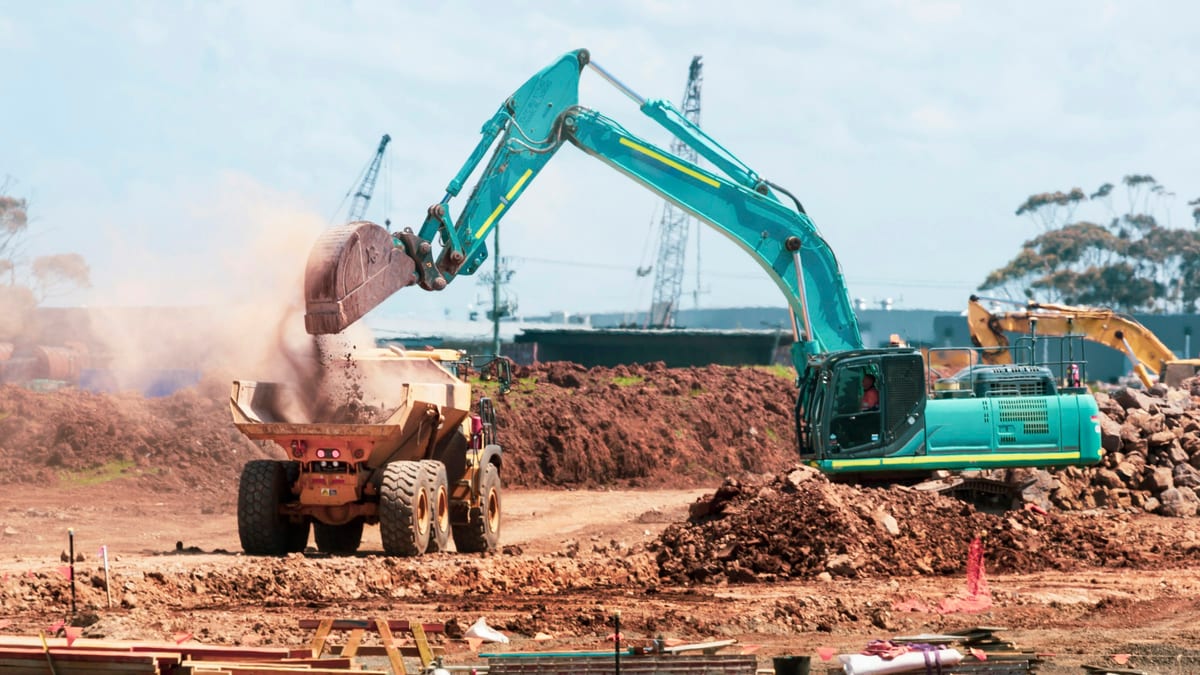
The milestone this round is priced against is ten weeks old. On 17 August Bedrock said its retrofitted excavators were performing paid work on live commercial sites with no operator aboard, with Sundt, Zachry Construction Corporation and Champion Site Prep named on specific projects. That was the technical claim. This round is about distribution.
The release names eight customers beyond that original three:
- Haydon — a remote site in Texas
- Wagner Construction (Minnesota)
- Smith Trucking Company (Florida)
- B&S Site Development (Virginia)
- Native Excavating (Colorado)
- Clarkson Construction (Missouri)
- C.W. Matthews (Georgia)
- selected ArchKey Solutions projects (Arkansas)
The release attaches a state to each name, eight in all — Texas, Minnesota, Florida, Virginia, Colorado, Missouri, Georgia and Arkansas. It does not attach contract values or machine counts to any of them, and it describes the growth in relative terms: Bedrock, it says, “has more than doubled its total customer volume since 2025.”
Haydon is the one the release develops. The Tempe, Arizona firm is 100% employee-owned — its own site says so — and the release says it is deploying Bedrock for fully autonomous earthwork on a remote Texas site, with plans to test trench work and larger machine models. Katie Haydon, the company’s chief executive and chair, tied the decision to the ownership structure: “As an employee-owned company, our people are at the heart of everything we do.” The technology, she said, helps the firm “take on more of the work our communities need, without placing additional strain on our crews,” and might let crews “accomplish more in a single shift, get them home safely.”
That is the same careful framing Sundt used in August — utilisation and shift quality, not headcount — and it is worth noting how consistently contractors who go on the record about autonomy choose those words.
The Two Hires Are the Tell
Two appointments are announced alongside the money, and in a scaling robotics company they are more diagnostic than the round size.
Amy Jones Satrom joins as vice president of operations, which the release describes as bringing experience deploying complex physical systems; her background, per the release, is Amazon, Nuro and Uber. Lando Juarez joins as general counsel after serving as head of legal for Uber’s Autonomous Mobility & Delivery business.
Read those two roles together. A fleet of uncrewed excavators on eight states’ worth of active jobsites is an operations problem — technicians, spares, uptime, site onboarding — and a liability problem. Hiring a general counsel out of an autonomous-vehicle programme is what a company does when it expects to be negotiating indemnities with general contractors and their insurers, not when it expects to be doing demos. This is analysis rather than anything the release says, but the pairing is a reasonable signal of where the next year’s difficulty is expected to sit.
Boris Sofman, co-founder and chief executive, put the use of proceeds in roughly those terms: the funding, he said, “allows us to expand deployments, strengthen the field operations behind every machine, and work with more partners as they integrate intelligent systems into everyday work.” He also staked the company’s claim on the August result — “We have proven that fully autonomous excavators can perform real work of value alongside the crews and workflows already in place on job sites.”
Bedrock’s own about page lists four co-founders: Sofman as chief executive, Kevin Peterson as chief technology officer, and Tom Eliaz and Ajay Gummalla as vice presidents of engineering. The release describes the company as founded in 2024 and led by former Waymo engineers.
Where This Sits in a Crowded Capital Year
Construction robotics has absorbed an unusual amount of money in 2026, and from several directions at once. SoftBank put $225 million into Autonomous Solutions Inc. and separately capitalised a construction joint venture with it; the venture’s size was not disclosed. Gravis Robotics raised a $200 million Series A, also with SoftBank participation, for retrofit autonomy on excavators. ICON took $200 million in a Series D for multi-storey 3D printing. Origin came out of stealth with $20 million for an interior-finishing robot.
What distinguishes Bedrock’s position is not the thesis — retrofit beats new iron, and the excavator is the right first machine — because that thesis is now shared. It is that the company has customers willing to be named on the record, repeatedly — which is, on our reading of this sector, scarcer than capital. A contractor’s name on a press release is a liability decision as much as a marketing one.
Jake Saper, a general partner at Emergence Capital, made the macro argument: “More than 20% of global GDP runs on industries that can’t hire the skilled labor they need, and construction is the sharpest example.”
What To Watch
Three things would tell us whether $4.1 billion was priced correctly.
Does the machine mix widen? Every named deployment so far is an excavator. Bedrock has talked about range for longer than that — the release describes it as “starting with excavators” and building toward mixed fleets, and Sofman told Construction Dive on 19 August that “excavators are only the starting point for Bedrock” — so Haydon’s stated intent to test trench work and larger models is the first time a named customer has been attached to anything past the current machine class. A dozer or a loader running the same stack on a named job would be the proof.
Does utilisation get disclosed? “More than doubled its total customer volume” is a growth rate without a base. Hours worked per machine per month, or cubic yards moved autonomously, is the number that distinguishes a fleet from a pilot programme — and Bedrock has disclosed volumes before: more than 65,000 cubic yards on an earlier Sundt site-preparation job, which we covered in August.
Does anyone else get named contractors? The competitive set is well funded and technically credible. If ASI, Gravis or a manufacturer’s own programme starts publishing customer names attached to operator-less work, Bedrock’s current advantage is a lead rather than a moat.