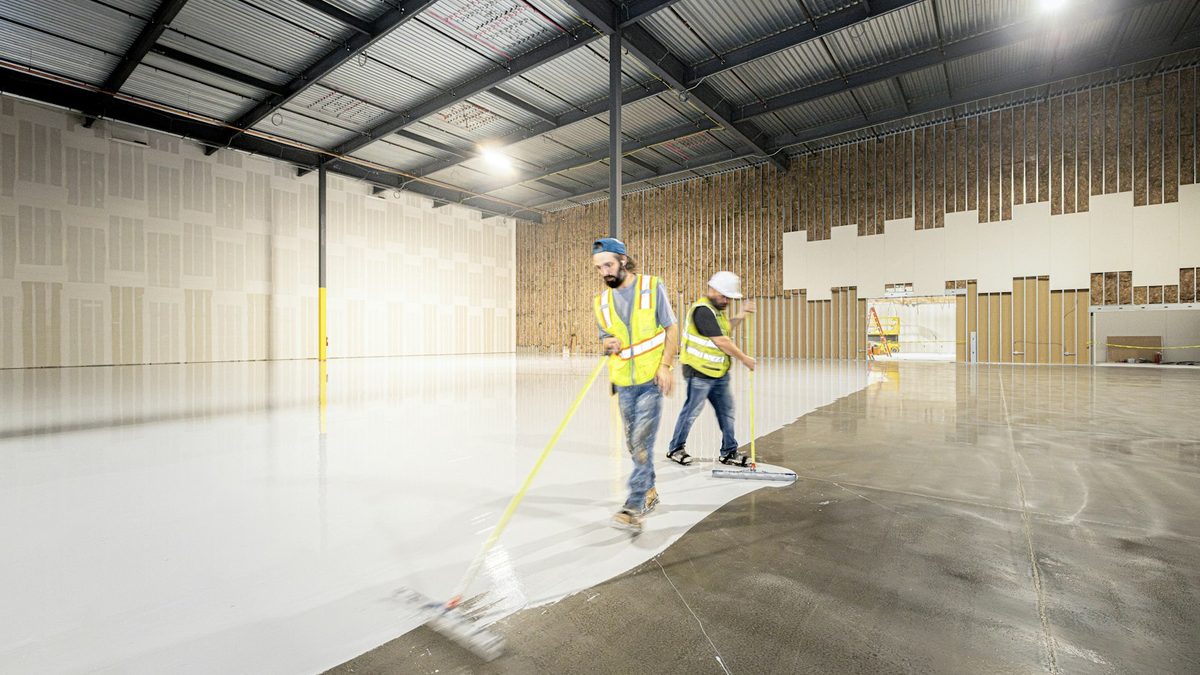
Origin, a San Francisco company building robots for interior construction, emerged from stealth on 15 October with $20 million in total funding, co-led by Accel and Zacua Ventures. Its flagship machine, OG-1, finishes walls: it applies compound, sands and primes, and the company says it does so without human intervention.
That is a narrower claim than “general-purpose robots for construction,” which is how Origin describes its ambition, and the gap between the two is most of what this announcement is about.
What Was Actually Announced
The release describes the money as “$20 million in total funding” rather than a round of a particular size or letter. It names no Series A, no seed, and no valuation; coverage of the announcement has not filed a round letter either, and no valuation figure has surfaced anywhere this publication could find. Alongside the two co-leads, the release names Unilazer Ventures, Schema Ventures, Z21, ISAI and Imad Ventures as backers, “alongside angel investors from Anduril, Skild AI, 1X and Tesla” — wording that reads as individuals from those companies rather than the companies themselves, and which is the detail that gave the trade press its headline.
Origin was founded in early 2025 by Yogesh Ghaturle, Ashish Daga and Tushar Makkar. Ghaturle co-founded Perpule, a Bengaluru cloud point-of-sale company, with Saketh BSV and Abhinav Pathak; Amazon acquired it in March 2021, and Origin’s release describes it as “a cloud POS company serving merchants across India and Southeast Asia”. Makkar heads autonomy, previously leading AI teams at Eightfold AI, and Daga leads hardware, previously building precision automation hardware at the digital-pathology scanner company Morphle Labs. Those two biographies come from the release and are reported here as its account.
Vivin Hegde, a founding partner at Zacua, has joined Origin’s board as a director.
One round-letter reference does exist, in the co-lead’s own write-up rather than in the announcement. Accel’s post on the investment, published the same day by Anagh Prasad and Subrata Mitra, says the team “moved from concept to live customer deployments in the U.S. all before hitting their Series A” — which places this money before a Series A rather than naming it as one. That post gives no valuation and no pricing model either.
The Machine, as Described
OG-1 moves on a three-wheeled platform with a 360-degree view of its surroundings, works at heights of up to 14 feet, and uses real-time force control to hold consistent pressure against a wall during contact-rich work like sanding. The release says it handles “targeted spraying and finishing high walls” as well as “difficult areas like corners, pillars, soffits and edges,” and that it is designed to work alongside crews while other trades continue around it, without a cordoned-off work area. Crews handle site mapping and material replenishment.
Underneath it is what Origin calls its Construction Action Model, which the release breaks into three parts: a reasoning system that plans and sequences sub-tasks, an action policy that handles navigation, tool use and quality assessment, and a controller that turns the policy’s decisions into feedback-driven motion. It is trained on high-fidelity simulation plus data from live deployments.
On results, the company is making a specific claim and it is worth quoting as a claim rather than paraphrasing as a fact:
“We spent 18 months building before coming out of stealth because we wanted to prove what our robots could do on real job sites,” Ghaturle said. “Today, our robots are already working at three times human speed, delivering human-level quality and generalising across different site conditions.”
Three times human speed and human-level quality are Origin’s figures, unaudited, and the announcement does not break them down by material, wall type or shift length. Nothing in the announcement puts an independent measurement behind them.
Origin says it deployed its first robots on New York job sites within 10 months of founding, and that OG-1 is now working across commercial spaces, multi-family apartments, data centres, hotels and warehouses. Origin’s own site puts the active fleet at four robots and more than 100,000 square feet delivered. The company trades as Artila Robotics Inc., per its site footer.
The pilots named in the release are where the next year is supposed to happen: “two of the largest drywall finishing contractors in the U.S.,” which the release does not name, plus additional pilots scheduled in Germany, Sweden, France and Saudi Arabia. The target is 150 robots deployed by the end of 2027, against the four the site currently shows.
Why Wall Finishing, and What That Costs the Pitch
Ghaturle’s framing for the trade selection is the strongest sentence in the release:
“Over the last century, construction has only mechanized or automated heavy exterior work. But much of the skilled work inside the building, which accounts for more than 65% of the construction timelines, is still done by hand.”
The 65% is Origin’s number and the release does not source it. The structural observation around it, though, is independently checkable against the funding record — and the cleanest check happens to come from the firm co-leading this round.
Zacua’s Construction Robotics Report 2026, published with Hilti Ventures and 94 Ventures, is cited in Origin’s own release for its headline figure: construction robotics “pulled in $1.36B of venture funding in the first three quarters of 2025, up 125% from the $612M raised in all of 2024”. The report puts that sum at “37% of all construction-tech capital in that period”, and says robotics still represents “less than 0.03 percent of global construction spend.”
Readers should weigh that the report’s publisher is an investor in the company announcing — Zacua co-led this round, and the report’s own source list includes Origin’s website. But the more useful number in it for understanding a $20 million cheque into wall finishing is one Origin’s release does not quote. The report breaks 2025’s funding down by workflow: “Heavy-equipment autonomy and reality capture raised about $98M and $112M per deal on average in 2025, while installation and task-execution robots averaged ~$27M across six rounds.” Its reading of that spread is that “investors are pricing earthmoving and surveying autonomy as high-conviction, later-stage bets, and installation / MEP automation as earlier-stage risk where evidence is still building.”
The analysis that follows is this publication’s own. Origin’s $20 million sits squarely inside that lower band, and the band is the point. On the report’s own per-deal figures, robotics capital has been priced very differently inside and outside the building. Outside is where the work is repetitive, the surfaces are large, the machine is a retrofit onto equipment a contractor already owns, and nobody is standing next to it — the thesis behind SoftBank’s $200 million Series A into Gravis Robotics and Bedrock’s $270 million Series B. Interior trades are the opposite on every axis: cluttered rooms, other crews working through the same space, tolerances judged by eye, and a finish a foreman will reject. A robot that sands drywall to a professional standard in an occupied fit-out is a harder engineering problem than an excavator that digs to a model, which is part of why the report finds a “3.5-4× gap in average round size” between the two.
The Question the Release Does Not Answer
Neither Origin’s release nor its site says how a contractor pays for the work — whether OG-1 is sold, leased, or billed against output. This publication checked the release, the company’s home page, its about page and its blog for lease, rental, subscription, per-square-foot or as-a-service language and found none, so no commercial model is reported here.
That gap matters more in interior trades than it sounds, because two of the most legible recent deals in the category are both defined by their pricing structure rather than their hardware. Monumental raised a $32 million Series B on the premise that it does not sell robots but sells finished walls. Human Friendly Robotics signed a three-year tiling contract worth up to $4 million in which the subcontractor says he pays per square foot installed rather than buying the machine. In both cases the capital risk, the maintenance and the downtime sit with the vendor, which is the arrangement a thin-margin specialty contractor can actually sign.
Origin’s announcement is silent on this, and the silence is not evidence either way — plenty of companies disclose pricing later. But a target of 150 robots by the end of 2027 is a manufacturing and capital commitment whose economics depend entirely on which side of that line the company lands, and the release asks readers to take the fleet target without it.
The Demand Argument
The labour framing in the release is sourced, and the source checks out. Origin cites “a 2026 survey” that “found that worker shortages delayed projects for 42% of responding U.S. construction firms.” The link goes to the Associated General Contractors of America, and AGC’s 3 September write-up of its survey with NCCER says precisely that: “Forty-two percent of respondents report that shortages of their own workers or subcontractors’ workers have delayed projects, making workforce shortages the most commonly cited cause of project delays.” The same survey reports that 74 percent of respondents experienced at least one significant project delay in the previous year, and that 37 percent had cut headcount by at least 5 percent over 12 months while 34 percent had increased it by at least 5 percent — a labour market that is tight and soft at the same time, which is the condition both Origin and its investors are selling into.
Hegde’s quote for Zacua puts the bet in the plainest terms available:
“Too many construction robots perform well in a lab and fail within a week on a live job site. Origin built for the job site from the start, and it shows in the results: the robot works, crews trust it and the company can manufacture it at volume.”
“Crews trust it” is the assertion to watch. It is not a specification and it cannot be measured from outside, but on an interior fit-out where a robot is working in the same room as the people whose trade it performs, it is the variable that decides whether 150 units in 2027 is a plan or a slide.