Disclosure: Groundworks is organised by Bricks & Bytes, whose weekly construction-technology funding roundup this desk reads as a routine check on the week’s deals, including today’s. Both announcements described below are wire press releases issued by the organiser.
A one-day event is not usually news. This one earns a story because of what it is choosing to be about.
On 29 October, Groundworks announced the demonstration line-up for its inaugural summit and said its initial capacity had been reached, with organisers working to open additional passes. The summit runs on 11 November at UCL Here East, in London’s Queen Elizabeth Olympic Park, and is built for roughly 150 senior decision-makers drawn from contractors, infrastructure developers, technology companies, investment firms and government.
The founder is Owen Drury, who co-founded the Bricks & Bytes podcast; Groundworks is the podcast’s event arm. In the 29 October release he describes the response as “overwhelming” and says there is a real appetite for understanding how robotics can be deployed on sites — bringing people together, in his framing, to see the technology, ask hard questions and learn from those already deploying it.
The Thesis, Stated in the Launch Release
The more revealing document is the earlier one. The launch announcement on 9 October set out the format: a single day, 10 to 15 main-stage sessions, an active demonstration area, and six focus areas — construction, infrastructure, manufacturing, energy, defence, and mission-critical facilities such as data centres and semiconductor plants.
It also set out the editorial line, which is unusually unkind for a conference pitching its own tickets.
“Shiny demos and talk are cheap if we can’t get these things working,” Drury said in the launch release, adding that “there’s still a big gap between seeing a robot in a demo and putting one to work on a live site.”
Each conversation, per that release, “will be grounded in three questions: Should we deploy? What should we deploy? How do we deploy?” That is a programme organised around deployment rather than capability. Reading anything further into it — that the sector has settled the capability question and moved on — is this publication’s inference, not a claim the organisers make.
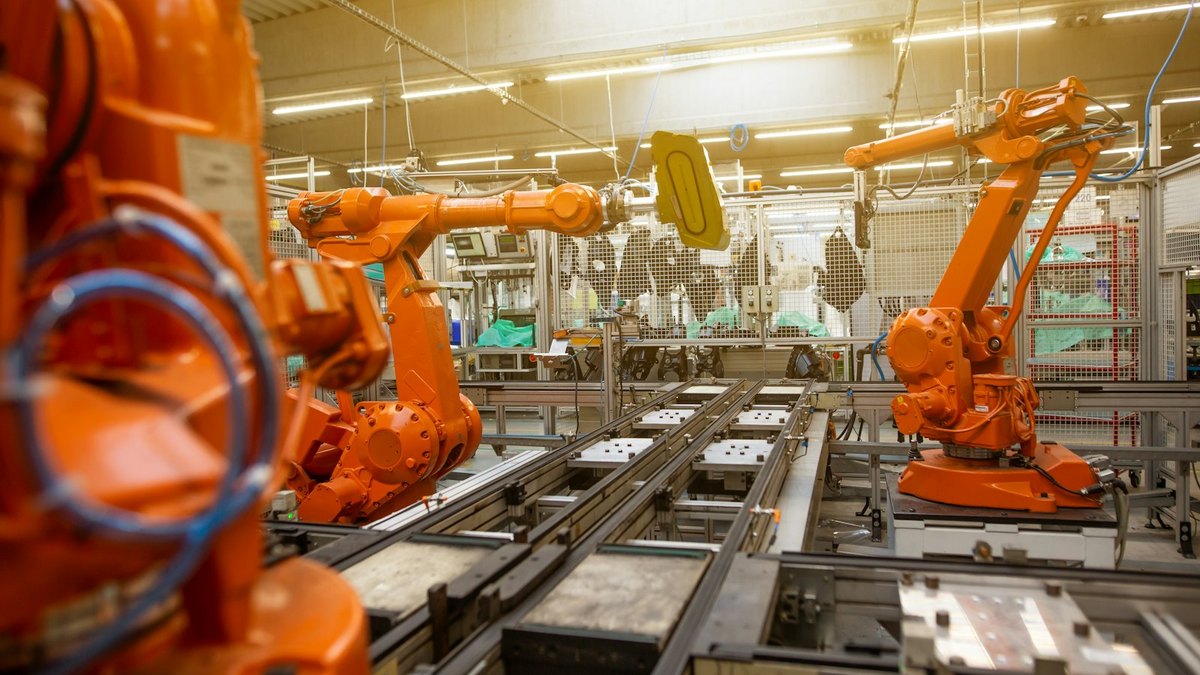
Manufacturing is the obvious benchmark, and the comparison that follows is this publication’s rather than the organisers’ — manufacturing appears in their material only as one of six focus areas. The International Federation of Robotics’ World Robotics 2025 figures, published on 8 April 2026, put Western Europe at 267 industrial robots per 10,000 manufacturing employees in 2024, with the EU-27 at 231, North America at 204 and a world average of 132. That measure counts industrial robots against manufacturing employees; a search of IFR’s published releases turns up no construction equivalent, and the obvious reason is that there is not yet an installed base to count. That is the gap the programme is named after.
Who Is Bringing Machines
The demonstration floor is where a conference becomes checkable, and the 29 October release names five participants: UCL, Hilti, Mechasys, Flo Mobility and Hyperion Robotics.
Two of them are worth knowing if you do not already. Mechasys is a Montreal company whose flagship is an XR Projector — a standalone, backpack-sized device that throws 2D or 3D CAD layouts onto floors, walls and ceilings, with a companion tablet and web application; its own line is “Bring your digital layouts to life with millimetric accuracy using projected reality.” Flo Mobility is a Bengaluru company that describes itself as India’s largest construction robotics service provider and sells autonomy as a service rather than as a machine — its Autonomous Cart, Unit 01, is tagged “1-Ton” on the site’s fleet listing and offered with “No capital cost, no infrastructure changes.”
The third familiar name is Hyperion Robotics, which raised $7.4m to print infrastructure in microfactories near the job site rather than in a precast yard — a Finnish company whose pitch is robotic 3D printing of low-carbon concrete parts for bridges, substations and water systems.
Set those three beside one another and what reads, to this publication at least, as a useful cross-section emerges: a layout tool that replaces a tape measure, a haulage robot sold by the month, and a printer that relocates the factory. None of the three is a humanoid; each attacks a different bottleneck — setting out, moving material, making the component. The organiser’s own summary of the floor is wider than the three profiled here, describing approaches ranging “from robotic bricklaying and automated timber production to drilling and layout technologies,” and UCL and Hilti are the two participants not covered above.
On the main stage, the 29 October release places senior representatives from Mace, VINCI, HS2, McKinsey and the UK Department for Business and Trade — two contractors, an infrastructure client, a consultancy and a government department, and not a robotics vendor among them. The programme is not aimed only at buyers, though: the same release says the discussions will cover “how contractors evaluate new technologies, what robotics companies need to achieve commercial scale,” and the role of physical AI in the future of construction.
Analysis: Why the Buyer-Side Framing Matters
What follows is this publication’s reading rather than anything the organisers claim.
The capital case for construction robotics has been settled loudly and recently. In the past fortnight alone this desk has covered Bedrock’s $600m Series C at a $4.1bn valuation, Origin’s $20m exit from stealth, and Shimizu taking a stake in a humanoid maker and starting the work inside BIM before any robot reaches a site. The money is not the constraint.
The constraint is everything a demo video leaves out: who signs the method statement, whose insurance covers an autonomous machine working near a banksman, what happens to the programme when the robot needs a flat floor and the slab is out by 15mm, and which budget line a subscription robot comes out of when the trade package was priced on labour. NIOSH’s bulletin on construction robotics, published on 7 October, is a federal document circling the same problem from the safety side: the engineering that works in a factory assumes a workspace that holds still.
A 150-seat room of contractors, developers and government that is explicitly not about capability is therefore a more useful signal than its size suggests. It says the vendors have stopped needing to prove the robot works and started needing to prove the site can absorb one. That is a later-stage problem than the sector had two years ago, and a harder one, because it is nobody’s product.
The reasonable scepticism is equally plain. This is an inaugural edition, organised by a media business, with its attendance figure supplied by that business and its speaker list described by organisation rather than by name. “Capacity reached” at 150 is a real but small number. The test of whether the framing is more than good positioning is whether anything said on 11 November is specific enough to be wrong.
What to Watch
Whether the client-side speakers name machines. Mace, VINCI and HS2 operating sites is the entire premise. A contractor saying which robot it ran, on what, and what it cost would be the single most useful disclosure of the day; a contractor saying robotics is an exciting space would confirm the gap the event named.
Whether the demo floor’s composition repeats. Layout, haulage and printing are the three categories that showed up for edition one. If edition two looks the same, that is the shape of the deployable market, not a booking accident.
Whether anyone brings adoption numbers. Manufacturing has a density statistic because somebody counts the installed base. For construction robotics the public record this desk can find runs to funding totals and pilot anecdotes. The field will know it has grown up when somebody publishes a denominator.