HD Hyundai XiteSolution has been selected to lead a South Korean government-funded project to build a simulation-based digital twin platform for AI-powered unmanned excavators. The company announced the award on 25 October 2026, and the Korean trade and business press reported it that day and the next. The Asia Business Daily gives the programme’s name in English as the “Development of a High-Precision Simulation-Based Digital Twin Platform for AI-Powered Unmanned Autonomous Excavators,” puts the budget at 6.33 billion won and says it runs through December 2029. The Seoul Economic Daily reports the same budget and end date and converts the figure to about $4.4 million. Both name the funder as the Ministry of Trade, Industry and Energy.
A note on the sourcing before the substance, because the English-language record here is messier than usual. The company’s name appears in three different forms across the outlets cited in this piece: the Seoul Economic Daily writes “HD Hyundai XiteSolution,” the Asia Business Daily writes “HD Hyundai Xite Solution,” and The Elec writes “HD Hyundai Site Solution.” The form used here is the one on the company’s own website, which describes the business as “Korea’s representative construction machinery company” and a “maker of hydraulic components, the core elements of construction equipment,” and which lists HD Hyundai Construction Equipment and HD Hyundai Robotics among its affiliated companies. The Korean name, HD현대사이트솔루션, is what the English variants are transliterating.
Two of these pages are machine-translated and say so: the Asia Business Daily notes that “this content was produced with the assistance of AI translation services,” and the Seoul Economic Daily carries a similar notice warning that quotations may not match the original Korean wording. The Elec’s English edition carries no such notice. The outlets also differ on the funding ministry’s English name — the Asia Business Daily and the Seoul Economic Daily call it the Ministry of Trade, Industry and Energy, The Elec the “Ministry of Trade, Industry and Resources.” Where the English reports diverge, this piece goes to the Korean ones.
The component list is the whole story
A digital twin in construction usually means a model of a building or a site. This one is a model of a machine, and the list of what it models is unusually specific for a press announcement.
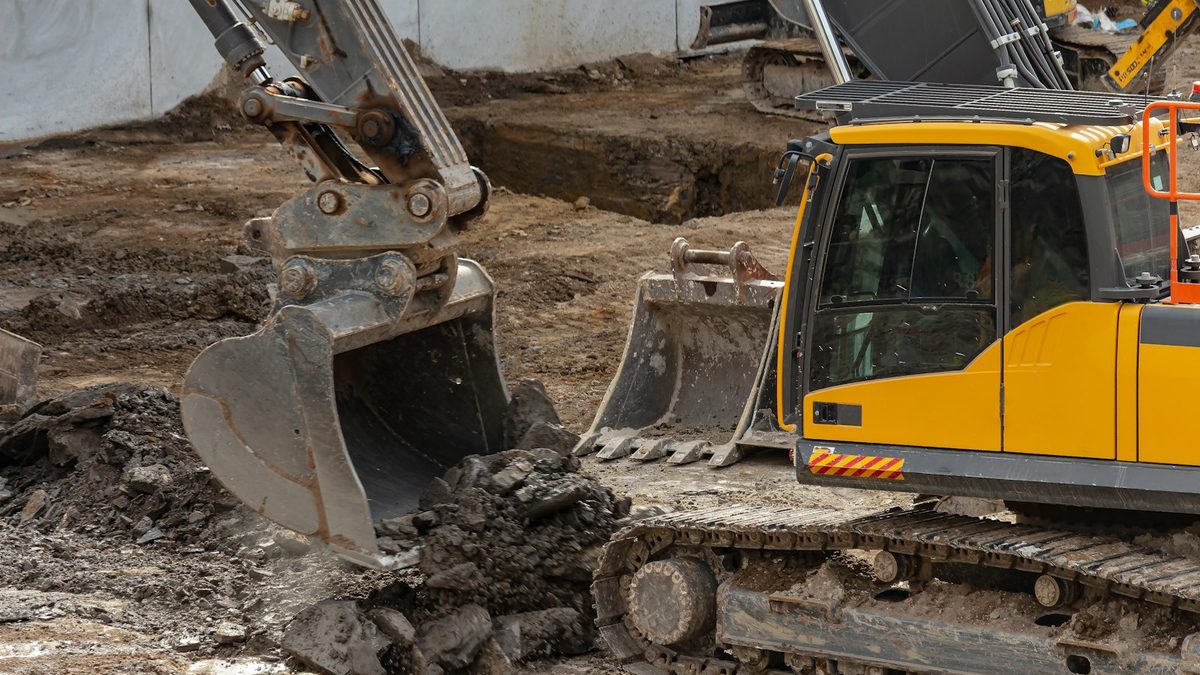
Per the Asia Business Daily, the platform is to recreate construction equipment operation in a virtual environment covering hydraulics, multibody dynamics and powertrains — and, separately, the physical interaction between the equipment and the soil. It says the scope spans designing key equipment, developing and training the AI unmanned technologies, and running field validation. The Korean reports specify the equipment as excavators, wheel loaders and articulated dump trucks (굴절식 덤프트럭). The Elec describes the same platform as recreating excavator operations and machine–soil interactions so that equipment design, autonomy development and the verification work that precedes field testing can be done virtually.
Three of those four items are conventional engineering simulation. Hydraulic circuits, multibody dynamics and powertrains have been modelled in commercial tools for decades; HD Hyundai XiteSolution’s business, by its own description, is hydraulic components, so it is modelling machinery its own group builds.
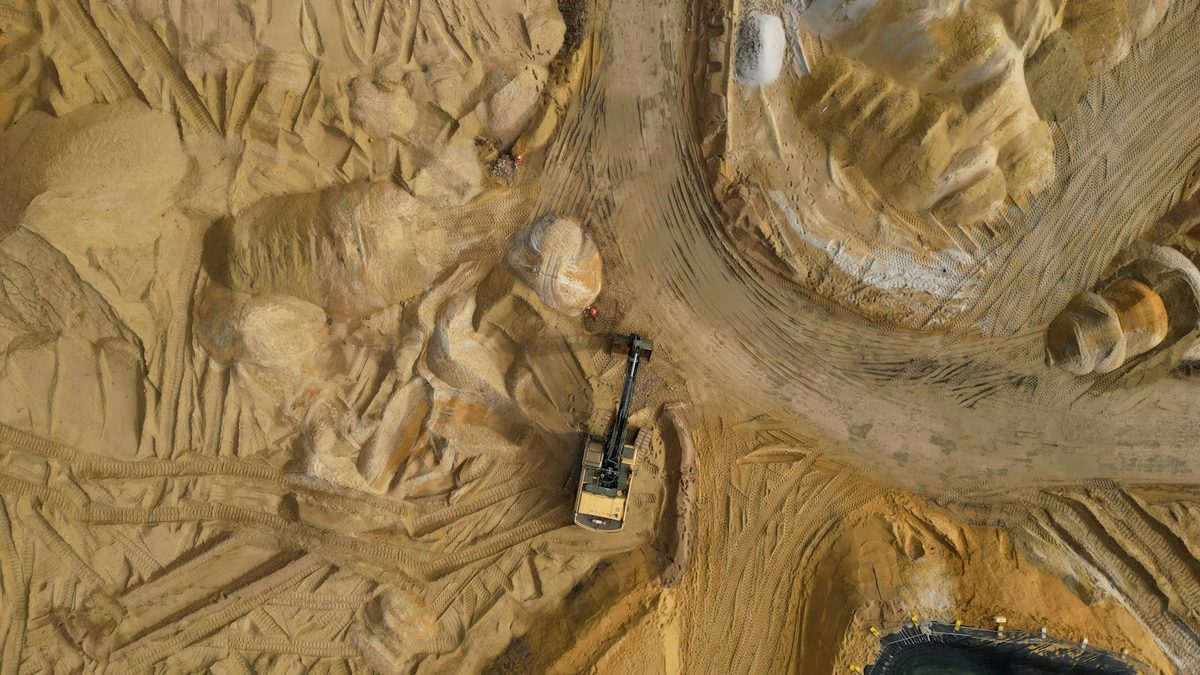
The fourth item is the one that is genuinely hard, and it is the reason this programme is worth more than a line in a funding roundup. Analysis: autonomous earthmoving is not fundamentally a navigation problem. A path across a site is a solved class of problem. The unsolved part is that a bucket entering a pile has to predict forces from a material whose behaviour changes with its composition and moisture — clay does not resist like gravel, and neither resists like either of them does after rain. That is a terramechanics problem, it is where the useful machine learning in earthmoving sits, and it is also the part that is most expensive to learn on real equipment because every training example costs a real bucket cycle, real fuel and real wear on a real machine. A simulator that models soil interaction credibly is an attempt to make those examples cheap. Whether this one will model it credibly is not something the announcements address, and simulation fidelity for granular material is an open research area rather than a settled capability.
Two bets about where autonomy gets learned
Set this against what the venture-funded side of the same problem is doing, because the contrast is clean and the two approaches are not obviously compatible.
Bedrock Robotics announced $600 million at a $4.1 billion post-money valuation on 26 October, the day after the Korean award was reported, and its approach is to retrofit autonomy onto excavators already working on live sites. Gravis Robotics took a $200 million Series A led by SoftBank. The premise in both cases is that the data you need comes from machines doing paid work in real dirt, and that the way to get it is to put units in the field and iterate.
The Korean programme inverts the sequence: build the virtual environment first, to December 2029, then validate in the field. It is not a strange choice. It is close to what Shimizu described for its humanoid programme — virtual simulations against its own BIM and CIM data first, physical robots on live sites after — and it is the standard arrangement in automotive and aerospace, where you do not learn a control policy by crashing the article. It also matches how national R&D money tends to work: a consortium, a shared platform, a multi-year horizon, and an output other firms can use.
Analysis, not reported fact: the two approaches differ on an empirical question this desk has not seen settled, which is how much of autonomous earthmoving transfers from simulation to a site. If soil interaction simulates well, a cheap simulator beats an expensive fleet and the Korean sequencing is the efficient one. If it does not — if the residual that only shows up in real material is large — then the fleet-first companies are buying the only data that counts and a 2029 platform arrives late to a question already answered in the field. This desk does not know which is true, and the documents reviewed here do not claim to.
What HD Hyundai XiteSolution is actually on the hook for
The company’s own scope within the consortium, as reported, is narrower than “build an autonomous excavator,” and the distinction matters for reading the announcement.
Both the Asia Business Daily and The Elec describe its role as defining the standard requirements for a virtual simulation component database, carrying out field validation, and evaluating operational scenarios. That is the role of the party that owns the real machines and runs the validation testing — it supplies the ground truth the simulation is calibrated against and judged by, and it says what a component model has to contain before anyone can use it.
The English-language reports render the consortium inconsistently, which is a reason to go to the Korean ones. ZDNet Korea and the Aju Business Daily both give the partners as ㈜심지 (SimJi), 한국건설기계연구원 (the Korea Construction Equipment Research Institute), 한국생산기술연구원 (the Korea Institute of Industrial Technology) and 한국건설기계산업협회 (the Korea Construction Equipment Manufacturers Association). That settles the two names the English reports disagree on: The Elec’s “SimG” and “Korea Construction Equipment Technology Institute” and the Seoul Economic Daily’s “Simji Co.” and “Korea Construction Equipment Research Institute” are competing transliterations of 심지 and 한국건설기계연구원, not different organisations.
On motivation, The Elec ties the project to a global shortage of skilled construction workers and rising demand for safety — the same framing that sits underneath nearly every autonomy round this desk has covered, and the same one that underpins Caterpillar’s work with FieldAI on perception rather than machine control. The Aju Business Daily quotes 곽성규, the executive in charge of virtual technology at the company — romanised as Kwak Seong-kyu by the Seoul Economic Daily and Kwak Seonggyu by the Asia Business Daily — saying “건설기계 산업의 AI 자율화를 이끌 핵심 과제에 참여하게 돼 뜻깊게 생각한다,” which the Seoul Economic Daily renders as finding it “meaningful to take part in a core project that will lead AI autonomy in the construction machinery industry.” The Asia Business Daily attributes a further remark about improving “safety and productivity at construction sites of the future” to the same executive.
What to watch
The headline number is small and the timeline is long. At the Seoul Economic Daily’s conversion of about $4.4 million, 6.33 billion won is under one percent of what Bedrock raised in its Series C, and December 2029 is three years and two months from now — long enough that a venture-backed competitor could reasonably expect to have shipped two or three generations of hardware into the same market in the interval.
That asymmetry is not necessarily a weakness, because the two pots of money are buying different things. The Korean budget is buying a shared simulation platform and a component database; the venture money is buying deployed units and the data they generate. The question worth tracking is whether the platform’s outputs are made available beyond the consortium. A component database that Korean equipment makers and their suppliers can all build against would be infrastructure, and infrastructure is a plausible thing for a trade ministry to fund. The announcements reviewed here do not say how, or whether, access will be granted outside the consortium, and we are not going to assume an answer.
The second thing to watch is when field validation actually starts. The programme assigns real-machine testing to HD Hyundai XiteSolution, but none of the reports reviewed here says where in the five-year schedule it falls — and that ordering matters more than the budget does, because a simulator is only worth what its calibration data is worth. If validation milestones become public, they will say more about this programme’s prospects than the headline figure will.