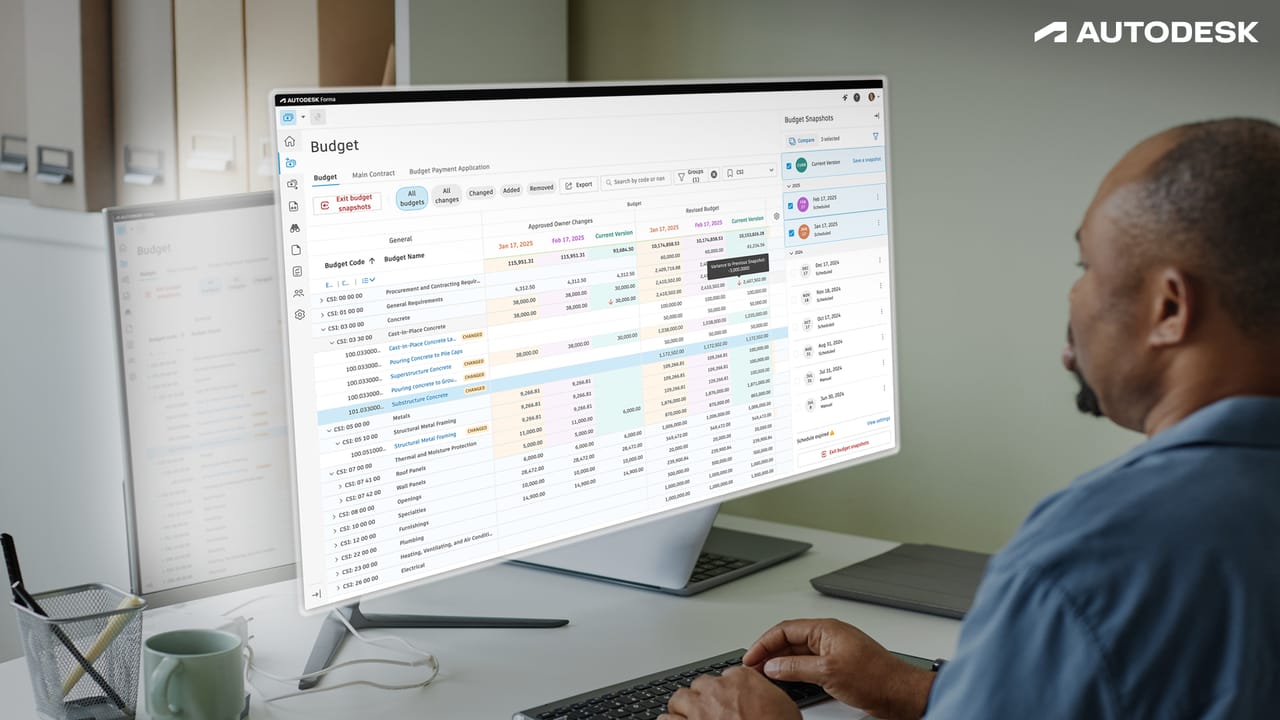

Autodesk University 2026 ran 15–17 September in Las Vegas. On the opening day the company published its agentic-AI announcements across its three industry clouds — Forma for architecture, engineering and construction, Fusion for design and manufacturing, and Flow for media and entertainment.
Two things came out of the week that matter to anyone running Autodesk software on a jobsite. One is an answer to a question the AEC industry has been asking since Forma was announced. The other is a date.
The Revit Answer
AEC Magazine reported that an FAQ published alongside the AU announcements asked directly whether Forma will replace Revit, and that Autodesk’s answer was “over time, yes.” Architosh reported the same answer, and carries the accompanying commitments verbatim where AEC Magazine paraphrases them: that more AEC work will happen directly in Forma, that “We will not force a sudden transition,” and that “We will continue investing in Revit to give customers a practical path toward that future.”
The wording matters, and it is worth being precise about whose wording it is: the quoted phrases above are from an Autodesk FAQ as reproduced by those outlets, not from a statement this newsroom obtained directly. Both are quoting the same Autodesk document, so this is two reproductions of one source rather than independent corroboration.
What changed is the status of the answer rather than the answer itself. Autodesk has been moving in this direction publicly for some time — this newsroom covered the point at which Autodesk Construction Cloud was folded into the Forma brand in March 2026. The difference now is that the succession is stated rather than inferred, and that Revit’s role in it has a name: a Forma Connected Client, the bridge rather than the destination.
Civil 3D joined Revit in that category this week, which AEC Magazine covers in detail, alongside a shared geolocation engine spanning Forma, Revit and Civil 3D, and a new Forma Street Design — for which Autodesk says “We are planning a beta and invite customers to join the waitlist,” so it is not in beta yet.
What Was Actually Announced for Construction
Autodesk’s own AEC-focused write-up names the construction-side pieces. The list is longer than the usual conference keynote, and the individual items are narrower and more plausible than the framing around them:
- Specialised construction agents — Autodesk says it is “expanding our set of specialized, AI-powered construction agents to support document search, submittal review, and bid proposal processing.” Note the verb: this is an existing set being extended, not a 2027 promise.
- A Daily Log Agent on mobile, which converts a superintendent’s spoken field update into a structured daily log.
- Forma Bid, bringing BuildingConnected bidding workflows into Forma, in beta for Forma for Preconstruction and BuildingConnected Pro subscribers.
- Drawing Change Analysis, which identifies meaningful differences between drawing revisions, and Drawing Compliance Review, which Autodesk’s write-up says is “planned for early next year.”
- Project Home in Forma Build, Forma Board for issues management, and Workflow Studio for custom processes.
Submittal review is the one to watch, because it is the workflow Autodesk bought six years ago. Autodesk announced the acquisition of Pype on 22 July 2020, a company whose AutoSpecs product generated submittal logs automatically; its co-founder has since raised $5 million to read drawings again at a new venture. Forma Bid has a similar lineage — Autodesk agreed to buy BuildingConnected for “$275 million net of cash acquired” on 20 December 2018, completing the deal the following January. An incumbent turning an acquired point tool into an agent inside the platform is the defensive move; the founder rebuilding it outside is the offensive one. Both are happening at once.
The Date Is the Story
Here is the part a construction technology buyer should read twice.
Autodesk says Autodesk Assistant “is generally available today across many Autodesk products, including Fusion, Forma, and Flow.” The next generation of it — the agent-first, standalone experience that carries almost all of the week’s ambition, including Personal Pulse, Assistant Spaces, the AI Orchestrator and Assistant Builder — was previewed at AU 2026 and is explicitly not yet generally available. The company’s own release says it is planned to begin rolling out in 2027, and that “availability, rollout timing, subscription terms, and regional details for these next-generation capabilities will be announced in 2027.”
That last clause is the one to sit with. Not just the software but the pricing is a 2027 disclosure. A general contractor deciding on a 2027 technology budget this autumn cannot cost this, because the terms do not exist yet.
What follows is analysis. There is nothing improper about previewing a roadmap at a user conference — that is what user conferences are for, and Autodesk was clearer about the gap between preview and availability than vendors often are. But the gap is real, and it lands in a market where smaller companies are shipping now. Motif shipped an agent-native BIM authoring tool with published per-user pricing on 8 September. Trunk Tools shipped Cortex with named agents attached to it. Those are not platform-scale products and they do not carry Autodesk’s install base, but they can be bought.
The counter-argument, and it is a strong one, is that Autodesk is not selling agents — it is selling the connected project data underneath them, which is the thing a point solution cannot assemble. The framing that AEC Magazine reported as “project intelligence” — the magazine’s characterisation of chief executive Andrew Anagnost’s pitch, rather than a phrase quoted from him — is about exactly that: the assistant is worth something because it knows the project, not because it can hold a conversation. If that is right, then the 2027 date is the cost of building the substrate properly, and the vendors shipping agents against disconnected data today are the ones with the harder problem.
This newsroom’s view is that both can be true, and that the practical consequence for a contractor is unglamorous: little announced this week forces a 2026 procurement decision. The construction agents, the Forma Bid beta and the Daily Log Agent are usable now if you are already inside the relevant subscriptions — that is the part to actually try. The next-generation Assistant is a reason to keep the seat count under review, not to move it.
What Is Not Known
Autodesk did not publish pricing, packaging or regional availability for the next-generation Assistant capabilities, and said explicitly that it will not until 2027. Beyond “planned for early next year” on Drawing Compliance Review, this newsroom did not find dated availability for the individual construction agents — document search, submittal review and bid proposal processing — and has not asserted one. Autodesk’s write-up does name two customers, but not against the agents: Kimley-Horn is quoted on an early version of Forma Street Design, and the Kraft Group on Forma Data Management at its stadium venue. No adoption or accuracy figures were published for any of the agents.
The checkable facts are the conference dates and location, the 15 September 2026 publication of the announcements, the product names above as Autodesk lists them, the 2027 rollout language quoted from Autodesk’s own release, and the “over time, yes” FAQ answer as reported by AEC Magazine and Architosh.