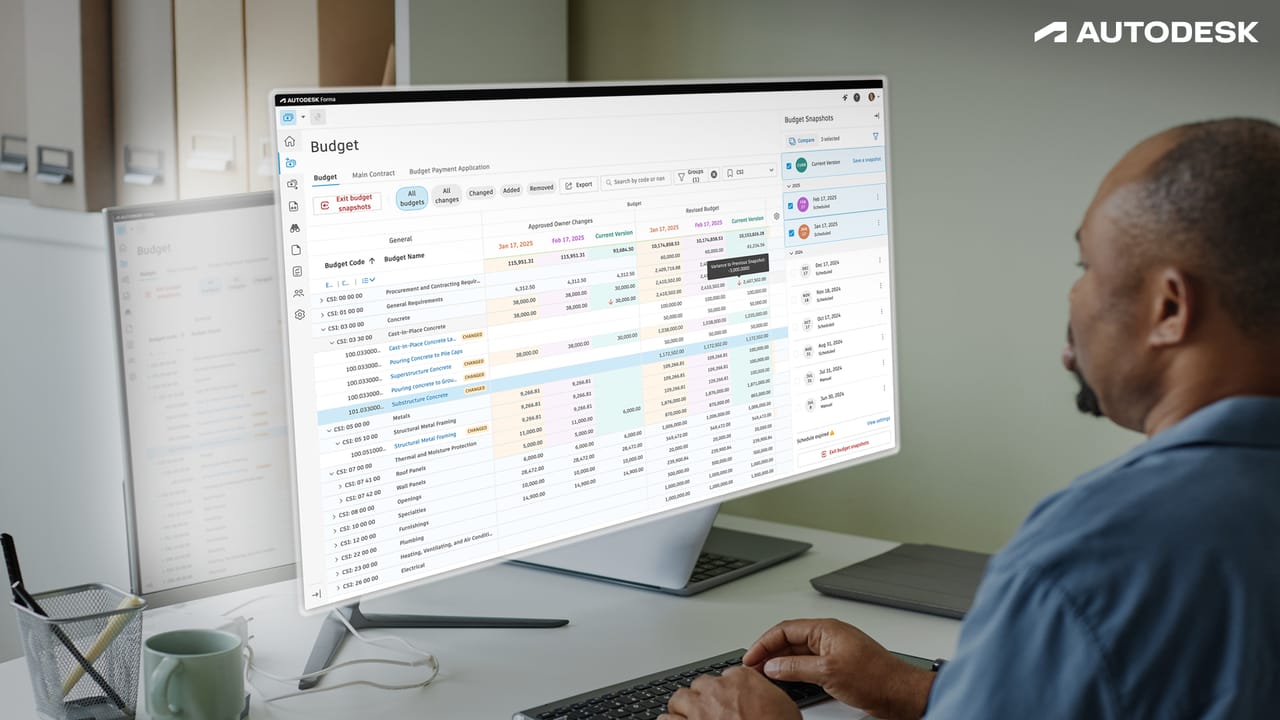
On March 24, 2026, Autodesk retired the Autodesk Construction Cloud name. Every product that lived under that umbrella — Autodesk Build, BIM 360, Takeoff, Cost Management — is now part of Autodesk Forma, the company’s unified industry cloud for architecture, engineering, construction, and operations.
If you are an existing Construction Cloud user, your login, your data, and the layout of the interface you use every day are unchanged. What changed is the brand, the stated platform philosophy, and — more significantly — the AI layer that Autodesk has been building toward since it first introduced Autodesk Assistant into the platform.
Understanding what the rebrand means in practice requires separating the marketing from the mechanics. The two are not the same thing, and the mechanics are what contractors and project teams need to evaluate.
Why Forma, and Why Now
Autodesk has been running two parallel construction product lines for several years: Autodesk Construction Cloud, which served the execution side of projects, and Autodesk Forma, which began life as a planning and early-stage design tool oriented toward architectural practices.
The decision to fold Construction Cloud into the Forma brand reflects Autodesk’s ambition to own the entire project lifecycle under a single platform umbrella — from early massing studies and environmental analysis through procurement, construction execution, and handover to operations. The argument is that breaking data silos between design and construction stages unlocks intelligence that neither side can access on its own.
The timing aligns with the broader push across enterprise software toward AI-native platforms. Autodesk’s framing of Forma is explicitly “AI native, cloud-first, end-to-end” — a set of principles that positions the platform not as a digitised version of existing processes but as a foundation designed from the start for AI-driven workflow automation.
What Is Autodesk Assistant, and What Does It Do Today
The centrepiece of Autodesk’s AI offering within Forma is Autodesk Assistant, a natural-language AI agent embedded directly in the platform. It is designed to let construction teams query project data — specifications, RFIs, issues logs, meeting minutes, submittals — without switching tools or building custom reports.
The Project Data Agent, which powers the core of Assistant’s project intelligence capability, exited beta in March 2026 — concurrent with the Forma rebrand. That timing is deliberate: it means the platform that launched under the new name also launched with its most significant AI feature generally available rather than in preview.
In practice, the Project Data Agent enables queries like: “Which RFIs are currently unresolved on the structural package?” or “Are there any issues flagged in the last fourteen days related to the mechanical room on level three?” The agent draws on the data already in the platform — it does not require additional tagging or configuration by the project team — and surfaces answers in context, alongside the source documents that support them.
Meeting minutes were added as a data source for the Project Data Agent alongside the March release, which extends the agent’s ability to connect formal written commitments from coordination meetings to open issues in the project log.
The Geometry AI Assistants: What Is Coming
The more forward-looking announcement embedded in the Forma transition is what Engineering News-Record reported as “geometry-based AI assistants” — AI models trained on the actual geometry of design files, not just the text and metadata around them, coming first to Revit.
The distinction matters. Most construction AI today works with documents: PDFs, text fields, issue logs. Geometry AI works with the building model itself — understanding spatial relationships, element types, connectivity between systems, and compliance with dimensional standards. Natural-language prompts for tasks like checking a drawing against a standard or querying the spatial layout of a specific system become possible without manual model interrogation.
This is meaningfully harder to build than document-based AI, which is why the timeline is “later this year” rather than available now. If Autodesk ships it with the depth of integration they have described, it would represent a qualitative step beyond what any construction platform currently offers.
What It Means for Contractors Using the Platform
For project teams already running on Autodesk Construction Cloud, the immediate practical impact of the Forma rebrand is minimal. The interface is the same. The existing integrations with Procore, Primavera, and third-party cost management tools are unchanged. There is no migration required and no new training burden.
The more meaningful changes are in the AI layer, which has been evolving incrementally over the past eighteen months and is now accelerating. Specifically:
The Project Data Agent is worth configuring and piloting on an active project. The value compounds with data quality: projects where meeting minutes, RFIs, and submittals are consistently uploaded to the platform will see significantly better results than projects where documentation is split across email and shared drives.
The AI Location Field Population — a smaller feature released in January 2026 that uses AI to suggest the correct location field when creating RFIs based on the context provided — is the kind of low-friction, high-frequency improvement that accumulates meaningfully across a large project.
The geometry AI assistants in Revit, when they arrive, will be worth evaluating for teams doing model-based coordination. The current gap between what AI can do with documents and what it can do with building geometry is large; if Autodesk closes it materially, the competitive implications for other platforms are significant.
The Honest Read
Autodesk Forma is a serious platform with a serious AI roadmap. The rebrand is also, in part, a repositioning exercise — a way of signalling to the market that Autodesk is not just an incumbent managing legacy software but a company building toward a coherent AI-native vision.
The question for construction firms evaluating their platform choices is not whether Autodesk’s vision is compelling — it is — but whether the execution timeline matches the urgency of their own digital transformation needs. The Project Data Agent is genuinely useful today. The geometry AI assistants are genuinely exciting and not yet available. The gap between those two things is where competing platforms are building their arguments.
For contractors already on Autodesk’s ecosystem, there is no reason to leave and some good reasons to deepen the integration. For those evaluating platforms fresh, Forma represents the most comprehensive stated roadmap in construction technology — with the caveat that roadmaps are promises, not deliveries.