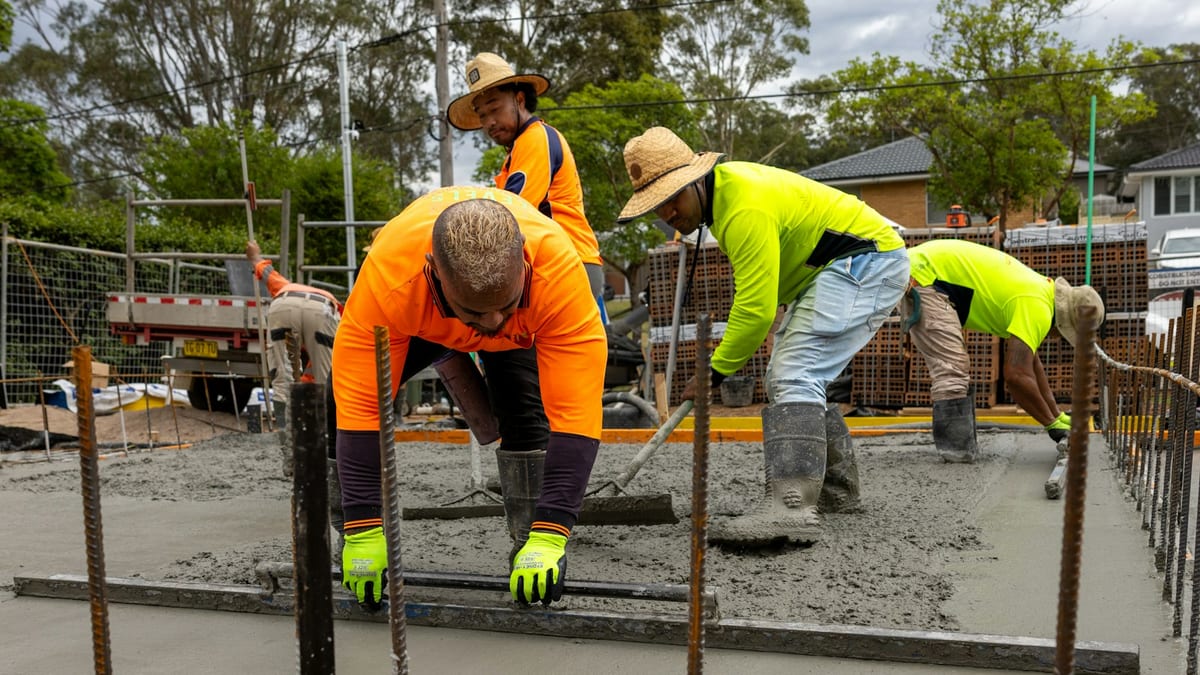
GreenVibe, a construction technology company based in Ramat Gan, Israel, has raised $12 million in seed funding to scale a system of wireless sensors embedded in concrete before it is poured, reporting strength and structural condition in real time. The round was announced on July 20 and raised in two phases.
The investor list is the story. Alongside Insight Partners, the round includes Tidhar Construction, Israel-Canada and Shikun & Binui — three of Israel’s major construction and real estate groups. No lead investor was identified in the announcement, and we have not been able to confirm one.
What the Product Does
Conventional concrete verification is a slow, indirect ritual. You take cylinder samples at the pour, send them to a laboratory, and wait — typically 28 days for the definitive strength result — while the structure you poured them from proceeds on the assumption that the concrete is fine. GreenVibe’s own framing is that this process involves eight separate steps of coordination, sampling, documentation, transportation and waiting.
Its alternative is to instrument the element itself. Sensors go into the pour, an IoT hub collects and forwards the data, and a cloud platform and mobile app report on the concrete in place. Per the company, the system combines five sensing technologies including ultrasound, measures strength alongside temperature, workability, density and humidity, and delivers readings every 30 minutes.
The precision claims vary by source, which is worth flagging: GreenVibe’s own site cites 92% data accuracy, while trade coverage of the round reported up to 95% correlation with the concrete actually poured. Treat the specific figure as unsettled; the directional claim — that in-place measurement beats a lab cylinder as a proxy for what is actually in the building — is the one the round is funding.
Deployment, as reported at announcement: more than 10,000 sensors across over 20 projects and laboratories. Roee Reshef is chief executive and a co-founder.
Why the Cap Table Is the Signal
Tidhar, Shikun & Binui and Israel-Canada are not venture funds dabbling in construction. They are firms that pour concrete for a living, and they have chosen to fund a technology whose entire function is to produce an objective, timestamped, third-party record of whether their concrete met spec.
That is a more interesting decision than it first appears, because such a record cuts both ways. A sensor that proves the pour was good on the day is a defence against a future claim. A sensor that proves it was not is a discoverable document. Contractors funding a system that grades their own work — and generates evidence either way — suggests they have concluded that certainty is worth more to them than ambiguity. In an industry where structural disputes are litigated for a decade on the strength of a handful of lab cylinders, that is a rational bet, and a telling one.
It also fits a pattern we have covered before: DPR and Suffolk Technologies investing in Skillit on the argument that construction’s labour problem is really a data problem. Large contractors are increasingly not just customers of construction technology but underwriters of it, and they tend to fund the things that reduce their own risk rather than the things that look most like software.
The Customer Question
GreenVibe’s own website names no customers, listing only partner logos. Trade coverage of the round is more specific: Instrumentation Monthly reported deployments including Ferrovial’s Malpartida bridge in Spain, a pilot with the US contractor Clark Construction, and a list of Israeli projects including work by Tidhar and Amot.
Those names appear to originate with the company and reach the press through the announcement rather than through independent confirmation, so we are reporting them as the trade press reported them, not as verified deployments. The Clark engagement in particular is described as a pilot — which is the correct word for it, and a different thing from a rollout.
Where It Fits
Concrete is the most-used construction material on earth and among the least instrumented. The recent wave of concrete-adjacent startups has mostly attacked either the material’s carbon problem or its repair burden — Sitegeist raising €4 million to point robots at Europe’s crumbling concrete, Hyperion Robotics printing low-carbon structural parts in microfactories. GreenVibe is attacking the verification gap: the interval between placing concrete and knowing anything reliable about it.
That places it in the same conceptual category as the reality-capture wave, and for the same underlying reason. The most valuable thing in construction data right now is ground truth about physical conditions — the reason Procore paid $845 million for DroneDeploy’s visual record and the reason Structured AI raised $4.2 million to put an AI inspector on every drawing. A camera tells you what a wall looks like. A sensor in the pour tells you something a camera fundamentally cannot.
What to Watch
The standards work is the real moat, and GreenVibe says proceeds will go partly toward integration into ASTM and Eurocode frameworks. This is the unglamorous determinant of the entire business: until a code official or a structural engineer of record can accept sensor data in place of a cylinder break rather than in addition to it, GreenVibe is an extra cost on top of the existing test regime rather than a replacement for it. Codified acceptance is what converts a nice dashboard into a line item somebody removes from the budget.
The second thing to watch is whether the contractor investors become reference customers who will speak on the record. Three construction groups on the cap table and no named Israeli contractor willing to put its name to a results claim would be a conspicuous gap. Closing it is the cheapest credibility GreenVibe can buy.