Gritt came out of stealth on July 21 with a $26 million Series A led by Obvious Ventures, bringing total funding to $32.4 million by the company’s count. Union Square Ventures and Active Impact Investments joined the Series A; First Round Capital, Climactic, Congruent Ventures and VSC Ventures had backed the earlier $6.4 million pre-seed. The company was founded by two Carnegie Mellon-trained roboticists, Puneet Puri (CEO) and Vishal Dugar (CTO).
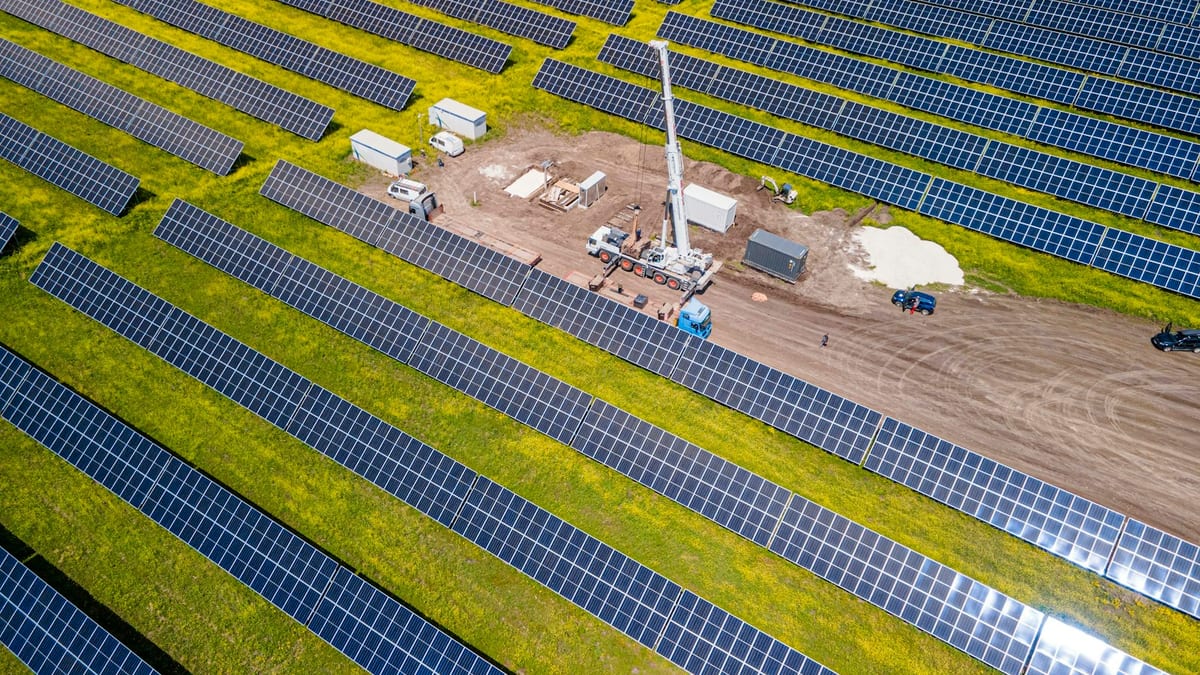
The product is a robotic arm with an AI system behind it that attaches to construction equipment crews already have — skid steers, forklifts — rather than a purpose-built machine. Its first job is building solar plants: unloading heavy glass panels, carrying them to the metal frames, and seating them with what TechCrunch reports Gritt describes as sub-millimeter accuracy. The company says the same platform handles pick-and-place, assembly and material transport, and that it has added lidar sensors and rebar-tying tools as it moves toward broader infrastructure work.
The Bet Against Building the Robot
Almost every well-funded construction robotics company of the last two years has made the opposite choice. Bedrock Robotics raised $270 million to bring autonomy to earthmoving equipment. Monumental raised $32 million to send its own bricklaying machines to America. Each owns the hardware, and each therefore owns the hardware’s cost, its supply chain, its maintenance and its depreciation.
Gritt’s argument is that the intelligence is the scarce part and the steel is not. If the arm bolts onto a rented skid steer and the manipulator is an off-the-shelf industrial unit from a manufacturer like Kawasaki, then the company’s capital requirement per deployed system collapses, and scaling looks more like shipping software than like running a factory. The company says training the system on a new task now takes days rather than months — the claim that matters most, because it is the one that determines whether “we do solar panels” ever becomes “we do infrastructure.”
That thesis is not free of risk. Renting your body means inheriting whatever the rental fleet gives you, and sub-millimeter placement on a machine you did not design is a harder controls problem than on one you did. It also concedes the durable moat that vertical integration buys: if the value is a model that drives commodity arms, the barrier to a competitor doing the same is lower than a decade of mechanical engineering.
What the Traction Claims Say — and Don’t
Gritt’s numbers, all company-stated and relayed through TechCrunch, are specific enough to be checkable later. Two systems are in the field today. The company plans 48 within six months. It says it is contracted to install 2.8 gigawatts over the next 18 months. And it claims an eight-person crew that installs roughly 800 panels a day gets to 3,000–4,000 with its systems running — a fourfold-plus productivity claim that is the entire commercial case.
The customers behind that contracted pipeline are not public. TechCrunch describes them as “three of the top 10 U.S. power construction companies,” and reports that a customer who spoke to the publication declined to be identified for competitive reasons. Gritt’s own site uses a similarly generic formulation. So the pipeline figure rests on the company’s word plus one anonymous corroborating customer — better than nothing, and short of confirmed.
The 2.8 GW figure is worth holding lightly for a second reason: “contracted” over 18 months, with two systems deployed and 46 more to build, is a statement about a sales pipeline and a manufacturing plan at least as much as it is a statement about installed capability.
Why Solar First
Solar is the right wedge for a company with this thesis, and not only because of the energy build-out. A utility-scale solar farm is the most repetitive large-scale construction task in existence: the same panel, the same torque, the same motion, several hundred thousand times, on flat ground, with no interior, no trades stacked on top of each other and no architect changing their mind. It is the closest thing outdoor construction has to a factory floor.
That is what makes it a good first market and a poor proof of the second one. The step from a solar field to a data center — Gritt names data centers, bridges and roads as follow-on markets — is a step into congestion, sequencing, and the coordination problems that have defeated jobsite robotics before. The interesting question is not whether the arms can place panels. It is whether “training in days” holds when the task stops being identical every time.
Where It Fits
The round lands in a category that is quietly bifurcating. Xpanner raised $18 million selling automation as a subscription rather than a machine. TerraFirma raised $115 million to run existing equipment from a screen. Gritt, Xpanner and TerraFirma are all variations on one idea: the installed base of construction equipment is enormous, mostly not owned by the people innovating on it, and can be upgraded in place. The vertically integrated robot builders are betting the opposite — that you cannot retrofit your way to real autonomy.
Both camps now have serious money behind them, and unusually for construction tech, the two theses are directly falsifiable against each other on the same jobsites within a couple of years.
What to Watch
The 48-system target is the near-term test, and it is a manufacturing and deployment question rather than an AI one. Going from two systems to 48 in six months means solving hiring, field service and integration with three large contractors’ operations simultaneously — the stage where robotics companies usually discover what their pilot did not teach them.
The longer test is a named customer. Right now the strongest public evidence for Gritt’s productivity claim is Gritt. If one of those top-10 power contractors puts its name to the panels-per-day number, the story stops being a thesis and starts being a result.