
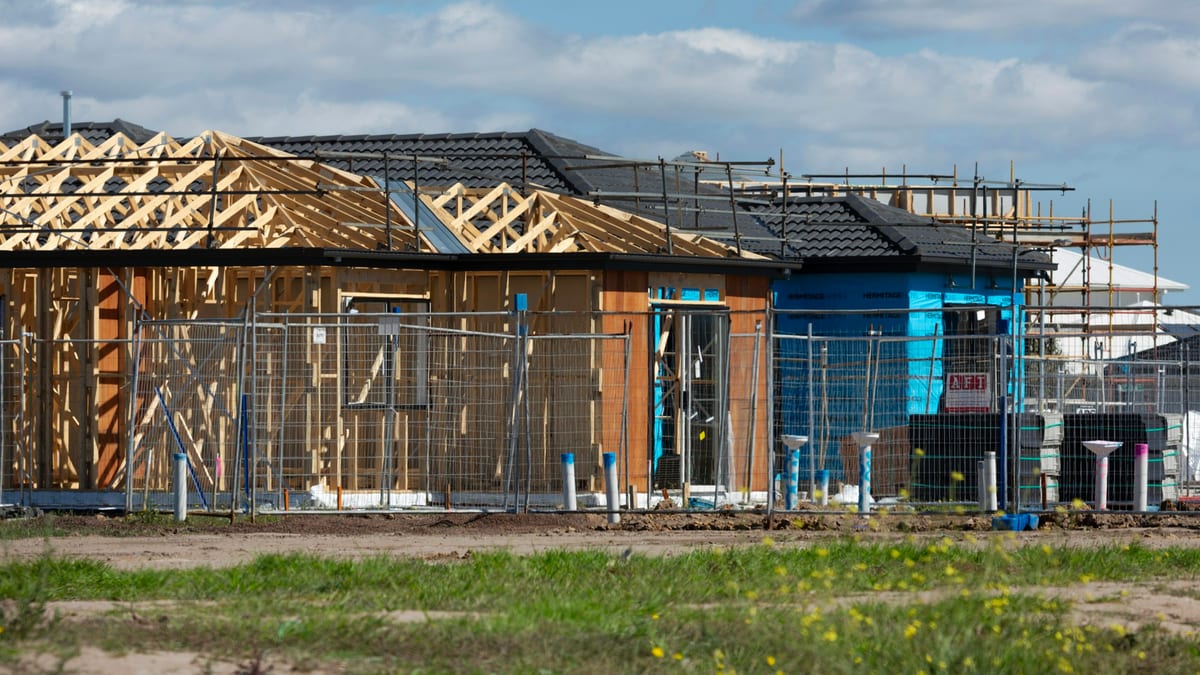
FormX, a Bay Area company that designs, permits and builds custom homes, has raised $12.5 million in seed funding led by Grove Ventures, with participation from Poalim Equity, At:inc and Script Capital. The company announced the round on 31 July, and Sidley Austin, which advised FormX, confirms the same amount, round type and investor list.
The announcement describes an AI platform that streamlines design, engineering, planning and permitting. FormX’s website, checked on 16 August 2026, does not mention AI anywhere we could find — not on the homepage, not on the solution page, not on the company page. It sells single-family homes, ADUs and backyard offices.
That gap is not a scandal. It is the most informative thing about the company.
Two Audiences, Two Stories
There is a straightforward reading here, and it is probably the right one: FormX is a homebuilder whose competitive advantage is internal software, and it markets to homeowners the way homebuilders market to homeowners — with delivery times, customisation and a single point of contact — while describing the machinery to investors in the language investors price.
That is a defensible way to run a company. It is also the inverse of how most of this sector works. Higharc raised a $95 million Series C selling a platform to production homebuilders. Illoca is building AI architectural design for designers. In both cases the AI is the product and the customer is already in the industry. FormX’s customer is a person who wants a house and does not care what generated the drawing set.
The consequence is that the usual evidence is unavailable. There is no seat count, no logo wall, no retention curve. The only proof that the software works is whether FormX can deliver homes faster or cheaper than the builder down the road — which is a real test, just a slow one.
What the Company Actually Claims
FormX’s homepage states the process can “move up to 70% faster than traditional stick-built construction.” A separate page puts a “40% Faster” figure against assembly time. Neither specifies a baseline, and it is not clear whether either includes entitlement and permitting time or only the build. “Up to” is doing real work in the first sentence. These are unaudited company figures, and the difference between a 70% reduction in construction duration and a 70% reduction in the calendar from first sketch to occupancy is the whole argument — the second would be remarkable, and it is the one the marketing implies without quite saying.
There is also an unresolved tension across FormX’s own pages about who does the work. One page says FormX “manages the entire process in-house, from concept and architectural design to permitting, engineering, and construction.” Another says the company works with “a network of certified GCs” and with partner architects, engineers and builders. Those can be reconciled — coordinating a partner network from a single point of contact is plausibly what “in-house” is meant to convey — but they are different operating models with different margins, and an investor reading the press release would not know which one they bought.
Founder and CEO Gal Rozensweig framed the thesis in the announcement: “Residential construction is one of the last major industries that hasn’t been fundamentally transformed by technology.” He is joined by co-founder and COO Shay Hasson and head of product Nami Gheidar, per the company’s site. FormX is listed as a licensed contractor operating out of Los Altos.
Permitting Is the Hard Part, and the Least Automatable
Of the four stages the announcement names — design, engineering, planning, permitting — the last deserves the most scepticism.
Design and engineering generation are well-trodden ground. Permitting is not a document problem that yields to better document generation; it is a queue problem distributed across thousands of jurisdictions with incompatible rules, review timelines and submission systems, and in California it is routinely the longest pole in a residential project. Software can shorten the preparation of a submittal and can check a set against code before a plan checker does. It cannot shorten a plan checker’s backlog.
Leading with ADUs is the sensible response to that, and presumably deliberate: it is the residential product category in California with the most demand and the most streamlined approval path, which makes it the best available place to demonstrate a compressed schedule.
Who Wrote the Cheque
Grove Ventures is an Israel-based pre-seed and seed firm with more than $500 million under management, investing in enterprise AI, deeptech, AI infrastructure and healthtech. It is not a construction specialist.
That is worth noting rather than criticising. The round is priced as an applied-AI bet, not a contech one, and the investor’s network will help with model infrastructure and hiring rather than with pulling permits in Santa Clara County. For a company whose stated bottleneck is regulatory throughput, the cap table is pointed at the other half of the problem.
What to Watch
The number that settles this is homes delivered, and nobody publishes it early. A software advantage in homebuilding only shows up at volume: the first ten houses are always slow, and the question is whether the eleventh is materially cheaper to produce than the first or merely faster to draw.
The second is geography. If the permitting capability is tuned to a handful of Bay Area jurisdictions, then expansion across California is a rebuild rather than a rollout, and the leverage evaporates at the county line.
The third is whether AI ever appears on the website. If the technology genuinely compresses the schedule, it eventually becomes a selling point to homeowners too — every builder in the state claims to be fast, and “we can prove it” is the differentiator. A year from now, a site that still doesn’t mention it will have told us something.