Shanghai Weijian Technology, a construction-robotics company that makes machines for plastering, spraying and rebar processing, has raised more than RMB 100 million from Caitong Capital. 36Kr (in Chinese), which carried the news as an exclusive, described it as the company’s fifth round of funding. DoNews, reporting the next day, labelled it a Series B. Neither report gives an exact amount or a valuation. Bricks & Bytes, which included the deal in its 23 November funding roundup, converted the sum to about US$14 million.
According to 36Kr, the money will go mainly to manufacturing and production, overseas market expansion, and continued R&D on its products and on embodied-AI technology.
The Company
Weijian was founded in June 2020 and is headquartered in Shanghai. Its English-language website, under the WEIBUILD name, lists plastering, spraying and modelling robots alongside rebar machining and threading systems.
Its founder and CEO, Liang Yanxue, holds bachelor’s and master’s degrees from Shanghai Jiao Tong University and a doctorate from the Tokyo Institute of Technology. 36Kr reports that he spent about ten years at the industrial-robot maker FANUC working on robot kinematics, dynamics and offline programming, then worked on localising lithium-battery equipment at CATL, and later headed the research institute at Bozhilin, where he was responsible for overall technical R&D.
DoNews, citing the corporate-records service Tianyancha, says Weijian previously announced a round of more than RMB 120 million in June 2022.
The Products, and the Company’s Figures
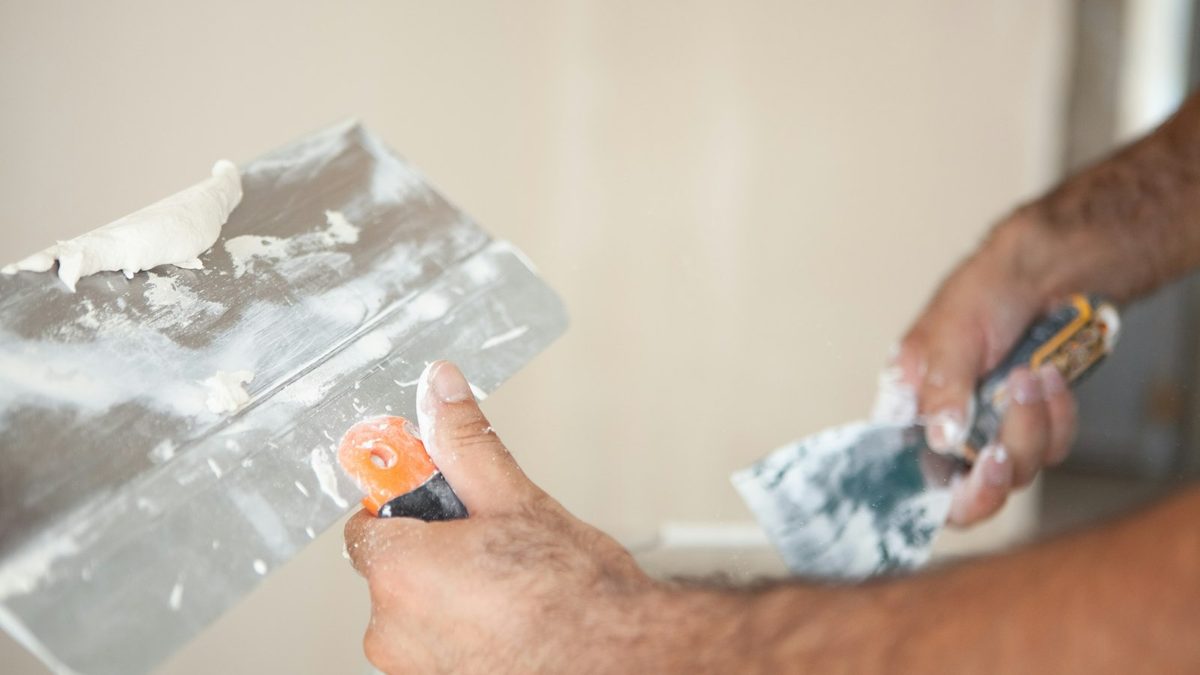
36Kr’s report groups the product line into two systems. The first is for wall work: the PMC-3000 and PMC-6000 plastering robots, PNP-3000 and PNP-6000 spraying robots, a MIB-5000 modelling robot, and supporting mortar and putty pumping equipment. The second is a flexible rebar processing centre, the RMC-40 series.
The performance figures are the company’s, as reported by 36Kr:
- Plastering: an average of 300 to 350 square metres a day, with a record of 708, and vertical flatness within 2 millimetres over 2 metres, against what 36Kr describes as a code requirement of 4 millimetres.
- Rebar: the processing centre needs two people to assist with loading and unloading and has an annual capacity of 20,000 tonnes; the company puts the labour saving at 90% and the reduction in waste at 80%.
- Orders: Weijian expects product sales orders to pass RMB 100 million in 2026, up more than 100% year on year.
42HOW, which published an English account of the 36Kr report, adds that the company’s robots have covered nearly 4 million square metres of construction area across more than 40 projects in 11 Chinese provinces.
On customers, 36Kr reports that Weijian has formed a joint venture with China Construction Eighth Engineering Division and works with other large Chinese contractors including China Construction Third Engineering Bureau, China Construction First Engineering Bureau, Shanghai Construction Group and Zhejiang Construction. Outside China, the report says, Japan’s Takenaka and the Middle Eastern companies ALEC, ACC and Sobha have begun using its products, and Singapore’s Housing & Development Board has procured its robots through a centralised tender. 36Kr also reports that a six-metre high-wall spraying robot was used on the NS Square project in Singapore.
The company’s own site says its plastering and spraying robot series passed EU CE certification in August, and describes a strategic cooperation agreement, signed through its Zhejiang operations centre, covering wall plastering and spraying on a 1,000-villa housing project in Kuwait.
Why the Founder Is Moving to Embodied AI
The most interesting part of the 36Kr report is not the round but the founder’s explanation of what the company is doing with it.
Liang told 36Kr that, for its first years, Weijian deliberately built what he called “disembodied intelligence” (离身智能): high-precision motion control and digitised process know-how, without relying on real-time perception of the environment or natural-language interaction. His argument, in our translation, is that in the vision-language-action models now fashionable in robotics, the vision and language are not what matters most for a robot — “action is what’s useful.” A precise measurement of a room, he said, “won’t earn me a cent”; the customer pays only when the plastering is done well.
Liang told 36Kr that early on the company brought in several master tradesmen, recorded and analysed their movements, and turned them into parameterised instructions in its own system, which it calls Tiangong.
From this year, Liang said, Weijian is moving towards embodied AI — and the reason he gives is not a technology trend but ease of use in commercial rollout. “Quality and efficiency we already guarantee with conventional technology,” he told 36Kr, “but if workers can’t use it, operating efficiency doesn’t go up.” Construction crews, the report notes, find entering coordinates and setting parameters too high a barrier; the company wants embodied AI to bring the threshold for operating the robots down far enough that front-line workers will actually use them.
Liang also said Weijian would not limit itself to construction. He told 36Kr that applications in “industrial-like” settings — he gave the example of spraying fire-resistant coatings on modular buildings for data centres — are already under internal discussion.
What the Investor Says
A Caitong Capital representative told 36Kr that a shortage of young construction labour is a global trend and that replacing labour with machines in construction “has gone from optional to a must-answer question.” Because sites are unstructured and processes complex, the investor said, only embodied AI with a closed loop of perception, decision and execution can genuinely put robots to work on site. The firm also said it believes Weijian’s capabilities can be replicated across processes and markets, and that labour shortages overseas are sharper than in China.
Why It Matters
Analysis. Most of the construction-robotics money this newsroom has covered this autumn has gone to equipment autonomy and factory production, with exceptions such as Origin’s $20M for a wall-sanding robot. Weijian is also working on the finishing trades — plastering and spraying — where the work happens inside a building under construction, and where the robot shares a floor with the crew that has to run it.
That is why Liang’s framing is worth taking seriously. He is not claiming that embodied AI makes the plastering better; he is saying the company’s existing approach already handles quality, and that the bottleneck to wider use is whether an ordinary site crew can operate the machine without specialist set-up. If that is right, the measure of this round will not be a model benchmark but the share of Weijian’s deployments that run without the company’s own engineers on site — a figure neither the company’s site nor the 36Kr report gives.
The overseas push also fits a pattern this newsroom has been tracking. Japan’s shrinking pool of construction trades is behind BALLAS’s ¥3.4bn Series B for steel fabrication, and Taisei’s ¥24bn corporate venture fund is aimed squarely at AI and robotics. Weijian’s investor is making the same labour-shortage argument, and the company has already put its wall robots through CE certification for Europe.