The Boring Company announced a $3 billion Series D on 9 September 2026, led by the United Arab Emirates and affiliated investment entities, at a stated valuation of $23 billion. The company lists Human Capital, Vy Capital, Valor Equity Partners, Sequoia Capital, Andreessen Horowitz, Temasek, Shamal Holding and Baron Capital among the other participants, alongside existing and new investors it does not name.
The use of proceeds, in the company’s own words, is to “significantly increase hiring across engineering, operations, and production, to build and scale Loop projects, including Vegas Loop, Music City Loop in Nashville, Dubai Loop, and others, in addition to accelerating the research and development of Prufrock and future products.”
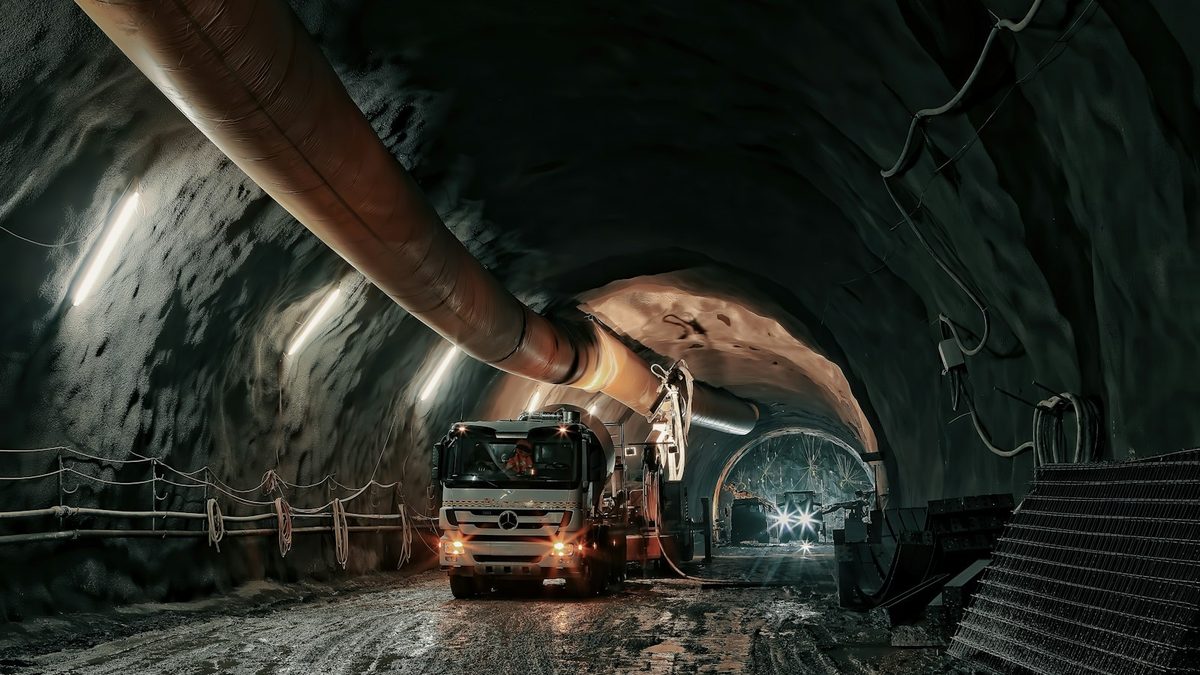
That last clause is why this belongs here rather than in a transport newsletter. Strip away the passenger-tunnel proposition, which is contested and will be argued about for years, and what is left is a heavy-civil contractor that has raised $3 billion partly to keep developing a tunnel boring machine it says is designed to operate with nobody underground.
What the Company Says Prufrock Does
These are The Boring Company’s own claims, taken from its Prufrock page, and are reported here with attribution rather than verified.
The page bills the machine as “The Fastest, Smartest, Safest Tunnel Boring Machine in the World” — a superlative this newsroom has not tested and does not adopt. The specifics underneath it are the interesting part.
Prufrock is “targeting a speed of 1 mile per week and an all-in cost of a Loop Transportation tunnel of less than $5M/mile.” Both are stated as targets, not achievements. The machine can be “remotely controlled from our Bastrop Operations Center” in Texas. The design goal the company names is “Zero-People-In-Tunnel (ZPIT)” operation — “to have zero people in the tunnel during normal operations” — which it characterises as “the safest, fastest, and least expensive method of tunneling.” The company also lists continuous mining, eliminating the stop-start cycle of conventional boring, and porpoising, the machine launching from and returning to the surface without a separate excavated pit, among its objectives. Two machines of the hard-rock variant, Prufrock-MB1 and Prufrock-MB2, are described as “currently mining the 10,000+ psi limestone in Nashville.”
The Construction Argument
What follows is this newsroom’s analysis.
Read that list without the branding and it is a very familiar argument, made with an unusually large amount of capital behind it. Every element — remove the operator, remove the stop-start, standardise the machine so you are not re-engineering it per project, vertically integrate design and manufacturing — is the same thesis that has been attracting venture money to construction robotics for three years.
It is the thesis behind Bedrock’s excavators running without an operator on named contractors’ sites. It is the thesis behind SoftBank’s $200 million Series A into Gravis Robotics, which retrofits autonomy onto machines contractors already own, and behind Xpanner’s $18 million for selling autonomy by the task. It is what Caterpillar’s collaboration with FieldAI is edging toward from the incumbent side — though, as we wrote at the time, that particular deal is about inspection and situational awareness rather than machine control.
The difference is direction. Those companies are trying to automate a machine that already exists, owned by a contractor who will not replace it. The Boring Company is building the machine, owning it, operating it, and selling the finished hole — which means the automation does not have to be sold to anyone. It only has to work.
That is a genuinely different bet about where construction automation pays. The retrofit thesis says the installed base is the moat and nobody will buy new iron. The vertically integrated thesis says the installed base is the problem, and the way to get an autonomous machine is to build one from scratch and never sell it. A $23 billion valuation is a large endorsement of the second answer — with the enormous caveat that the endorsement is priced off a transport business, not off a tunnelling-productivity business, and this newsroom has no visibility into how the investors weighted the two.
What Is Actually Built
Public reporting fills in what the funding page does not. TechCrunch reported the round on 10 September and reported the company’s stated plan to dig more than 150 kilometres of tunnel in the UAE, alongside operating tunnels in Las Vegas and a 10-mile Nashville loop recently started. Electrek reported the same round, put the $23 billion at roughly four times the company’s 2022 valuation of $5.7 billion, and reported that the Las Vegas system has carried over 4 million passengers, that Nashville received its state permit on 25 February 2026 with two Prufrock machines mining by August, and that the Dubai Loop pilot runs 6.4 kilometres with four stations. Those are Electrek’s and TechCrunch’s figures; this newsroom has not independently confirmed the passenger count, the permit date or the Dubai pilot dimensions.
The gap between a mile a week as a target and what the machines have actually delivered in Nashville limestone is the number that would settle the productivity question, and the company does not publish it on either page cited here. Nor does it publish an achieved cost per mile. Both are the figures a contractor would want before drawing any conclusion about tunnelling economics from this round, and both remain the company’s targets rather than its results.
What This Says About Where Construction Capital Went This Week
The 14 September issue of Last Week in ConTech lists nine construction-technology rounds for the week. Two of them account for most of the money: this one at $3 billion and Motive’s at more than $1.3 billion. Neither went to a company that reads drawings, writes schedules or watches a jobsite. One went to a fleet and equipment platform and one went to a company that digs. The rest of the list — Perry Weather at $110 million, Wint at $36 million, Buildcheck at $12 million, Strong by Form at €5.8 million, Wyre AI at $5 million — is the sector at its normal scale.
That contrast is worth sitting with, because the software end has had a strong year by its own standards. Buildots’ $130 million landed in the same window, and this year’s consolidation headlines are Autodesk’s $3.6 billion acquisition of MaintainX and Procore’s $845 million acquisition of DroneDeploy. Those are acquisitions rather than rounds, and the larger of the two is bigger than this week’s tunnelling cheque — the comparison is between different instruments and should not be pushed far. The narrower observation is the one worth keeping: the construction sector’s software companies raise in the tens and low hundreds of millions, and this week $3 billion went into steel, concrete and a machine instead.
Whether that is a signal about construction technology or simply a signal about Elon Musk’s ability to raise capital is a fair question, and the honest answer is that it is probably mostly the latter. But the use-of-funds sentence is the company’s own, R&D on Prufrock is named in it, and “zero people in the tunnel” is a construction-automation goal whoever is writing the cheque.
What Is Not Known
The Boring Company did not disclose the split between the UAE entities and the other named investors, the terms, the share of proceeds going to Prufrock R&D as against Loop construction, any revenue figure, or any achieved tunnelling rate or cost per mile. The 1 mile per week and sub-$5M per mile figures are explicitly stated by the company as targets. The “world’s fastest, smartest, safest” claim is the company’s own. This newsroom has not verified the Nashville, Las Vegas or Dubai project figures beyond the reporting cited above.
The checkable facts are the $3 billion amount, the 9 September 2026 date, the $23 billion valuation, the UAE as lead, the named participating investors and the stated use of funds — all from the company’s own Series D page.