Terabase Energy released the next generation of Terabase Construct on 16 November, from a Berkeley, California dateline — its construction software for utility-scale solar, storage and wind projects. The release went out over Business Wire, which returns a refusal to automated fetches; this publication read the full text through the syndicated copy carried by the Rutland Herald, which reproduces it under a Business Wire credit and points back to the canonical release ID.
Terabase is not describing this as a feature update. “With this release, Terabase is defining a new category for renewables: the AI construction execution system (AI-CES),” the release says — and it supplies its own definition of the distinction it is drawing: “Construction management software reports on what got built. A construction execution system helps teams act on what’s happening now.”
That is a positioning claim, and it is the company’s, not this publication’s. What can be checked is what the product does, and the release is dense with the kind of detail that is checkable.
The Agent Sits On Top of Three Data Feeds
Construct’s “interactive AI agent works inside the platform, drawing on daily drone imagery, field data from crews and live data from” what the company calls “the first native equipment tracking in utility-scale solar.” Terabase says the platform underneath it is “already trusted on more than 35 GW of solar, storage and wind projects” — a figure its own site repeats, attributing 35 GW to “projects supported by Construct construction management software.”
The agent’s described job is narrow and operational: “Ask in plain language, and the built-in agent answers, flags deviations from plan, builds custom reports and sets up the views you need, from flight comparisons to filtered QC lists.” The release’s summary of the benefit is one sentence: “Work that took an afternoon now takes a sentence.”
What makes the data feeds interesting is the capture model. “Unlike platforms that rely on periodic flights, contracted pilots or manual entry, Construct captures data across the entire build, from civil works through commissioning, with daily flights once installation is underway.” The fleet doing it is “an autonomous drone-in-a-box fleet” that the company says “flies more than 3 GW of active construction every day.” And because a solar site is mostly not near a cell tower, there is “a dedicated mesh network, reserved for Terabase drones and IoT devices”.
Then the equipment tracking, which is the detail most likely to stick: “A small magnetic beacon attaches to almost anything, from pile drivers to portable toilets.” Teams see “location, idle time and utilization on the digital twin, so crews get faster time to tools across thousands of acres and rentals go off-rent sooner.”
That sentence contains two separate business cases aimed at two separate buyers. Time-to-tools is a productivity argument about crews walking a site; going off-rent sooner is a cost argument about a rental invoice.
Energy Intelligence Is the Part That Closes the Loop
The capability the release describes in the most technical detail is the one Terabase calls Energy Intelligence. “From the first energized MV circuit, Construct uses PlantPredict, Terabase’s bankable energy model, to calculate what the as-built plant should produce and compare it with measured output, loss by loss, down to the tracker.”
The point of that, in the release’s words: “Teams can pinpoint the cause of underperformance instead of leaving it in an ‘unknown losses’ bucket.” And: “The same model sets the baseline for the Capacity Test.”
That closes a loop. The energy model written during development predicts production; the capacity test at the end measures the finished plant against a baseline. Running the same model against as-built geometry during construction, rather than only at handover, is — on this publication’s reading — what turns the final test into a confirmation rather than a discovery. The release does not quantify how often that changes an outcome, and this publication is not inferring a figure.
The surrounding features are consistent with that framing. Construct “compares what’s built against the design and flags deviations, like a misrouted MV feeder trench, before they get buried.” Automated QC runs on “IR drone flights and robotic array inspections,” with “every finding pinned to the exact element in the digital twin.” Hybrid sites are handled in one twin: “Substations, BESS, wind turbines and gen-tie lines are tracked in the same digital twin as the PV array,” across “hundreds of element types and subtypes, from individual pile and module variants to inverters and MV foundations, each with its own status and history.”
Pierre Gousseland, senior vice president of product and co-founder at Terabase Energy, puts the thesis in the release’s clearest terms:
“On a solar site, the cost of a problem depends on when you find it. A defect fixed on the row takes minutes. The same defect found at commissioning means a crew, a truck and lost days. Our new construction execution system moves the finding to the earliest possible moment, and on hundreds of megawatts that adds up to real time back on the schedule.”
A Contractor and an Owner, Both on the Record
The release quotes two people from outside Terabase, both named with their titles.
Joshua Hauger, director of construction at MasTec: “Terabase Construct connects our field teams and leadership through real-time visibility into project performance, helping us identify constraints earlier, improve accountability, and make better decisions.” He adds that it is “a great example of moving innovation beyond pilots and into everyday operations at scale.”
The MasTec name reaches this newsroom’s pages twice inside a fortnight. On 10 November, Gritt announced that MasTec Renewables — the parent’s renewables segment — would deploy its robotic attachments after evaluating them on live solar jobsites. Here a MasTec director of construction is the named voice in a software launch aimed at the same class of project. This publication has no basis for saying the two are deployed on the same sites, and is not suggesting it.
Amit Nadkarni, chief operating officer at Doral Renewables, is placed on the owner side of the argument: “Our pipeline is growing quickly, and delivering it on time takes real visibility. With every project in one portfolio view, our team works from the same data, spots issues early and manages more projects without adding layers of reporting.”
Worth noting precisely, because it is the kind of thing that gets rounded up: that quote names no product. It is positioned under Terabase’s description of the owner portfolio view, but Nadkarni does not say “Construct” and the release does not call Doral a customer. Hauger’s quote does name the product. The named Construct customer in Terabase’s own earlier material is EDP Renewables: the company’s site carries a news item headlined “Construct Platform Surpasses 2 GW with EDP Renewables.”
Owners are offered the handover artefact as well: “At handover, they receive the digital twin as a full, structured record of how each project was built.”
Analysis: The Argument Is About Megawatt Timing, Not Software
What follows is this newsroom’s reading, not a claim Terabase makes.
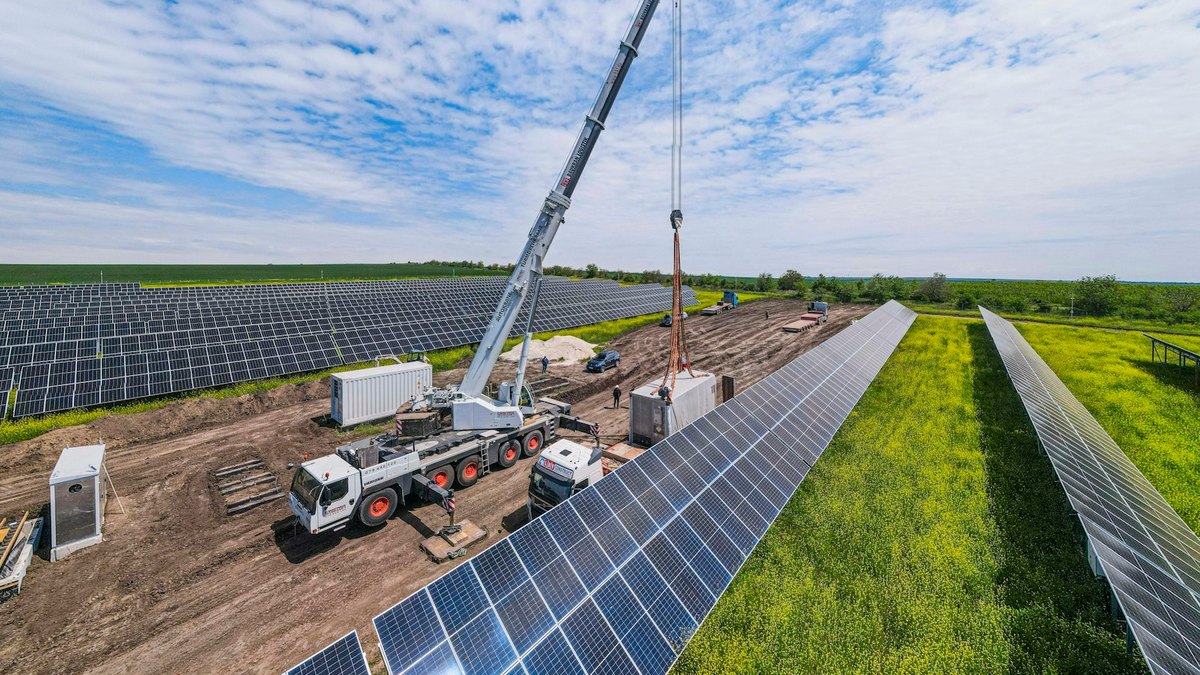
The release spends its third paragraph not on software but on the power market, and that is deliberate. “Data centers need new capacity now, gas turbines ordered today won’t ship until the next decade, and solar plus storage is the fastest way to add megawatts.” Terabase then offers a scale figure for the problem: “a single 300 MW site can span 1,500 to 2,500 acres, two to three times the size of Central Park, and progress is often still pieced together from daily reports and spreadsheets.”
Read as a sales argument, that is notably direct about what the product is for. It is not claiming to make solar construction cheaper in the abstract. It is claiming that the binding constraint on a gigawatt-scale buildout is how fast a developer learns something has gone wrong across two thousand acres — and that the answer is instrumentation density rather than better reporting. Matt Campbell, chief executive and co-founder, states it as: “Solar is the fastest way to add power, but only if the build keeps moving. On a site this size, speed comes from knowing sooner.”
Construct is one of four named parts of what Terabase calls its speed-to-power platform. PlantPredict does the energy modelling; Terafab “applies physical AI to solar construction, assembling modules onto trackers on site, around the clock”; Construct turns live data into action; and Terabase SCADA and plant controls, which the release says are “proven on more than 15 GW,” carry a plant from mechanical completion through energisation. That is a company that sells the model, the robot, the construction system and the controls for the same asset — a wide span, and the thing that makes the Energy Intelligence loop possible at all, since the baseline model and the construction record live under one roof.
The money behind it is substantial. The release says Terabase is “backed by more than $200 million from SoftBank, Breakthrough Energy Ventures, Prelude Ventures, Fifth Wall, SJF Ventures, EDP Ventures and others.” The round that took it past that mark was a $130 million Series C led by SoftBank Vision Fund 2, announced in March 2025 and carried in full on the site of SJF Ventures, one of its investors; that release says the round “brings the company’s total funding to over $200 million.”
On the category claim itself, this publication takes no position. “AI construction execution system” is a name a vendor has given to its own product, and whether it survives contact with other vendors’ marketing is not something a launch release decides. The claim of “the first native equipment tracking in utility-scale solar” is likewise Terabase’s, reported here as the company’s words rather than as a verified fact. The release does not define what “native” excludes, and this publication did not attempt to adjudicate a first-to-market claim it has no way to settle.
The release says Terabase would demonstrate the new Construct at RE+ 2026 in Las Vegas, 17–19 November, at Booth C6682 — an exhibition window that is open as this is published.