
OpenSpace used Waypoint 2026, its annual virtual customer event on 10 September, to set out the next version of what it calls the Visual Intelligence Platform. The announcement describes the company as “the Visual Intelligence Platform for the built world” and frames the release as “moving project teams beyond document-centric workflows toward decisions grounded in visual, real-world data.”
The announcement runs across spatial positioning, the mobile app, progress tracking and AI agents. The last of those carries the argument.
What Was Announced
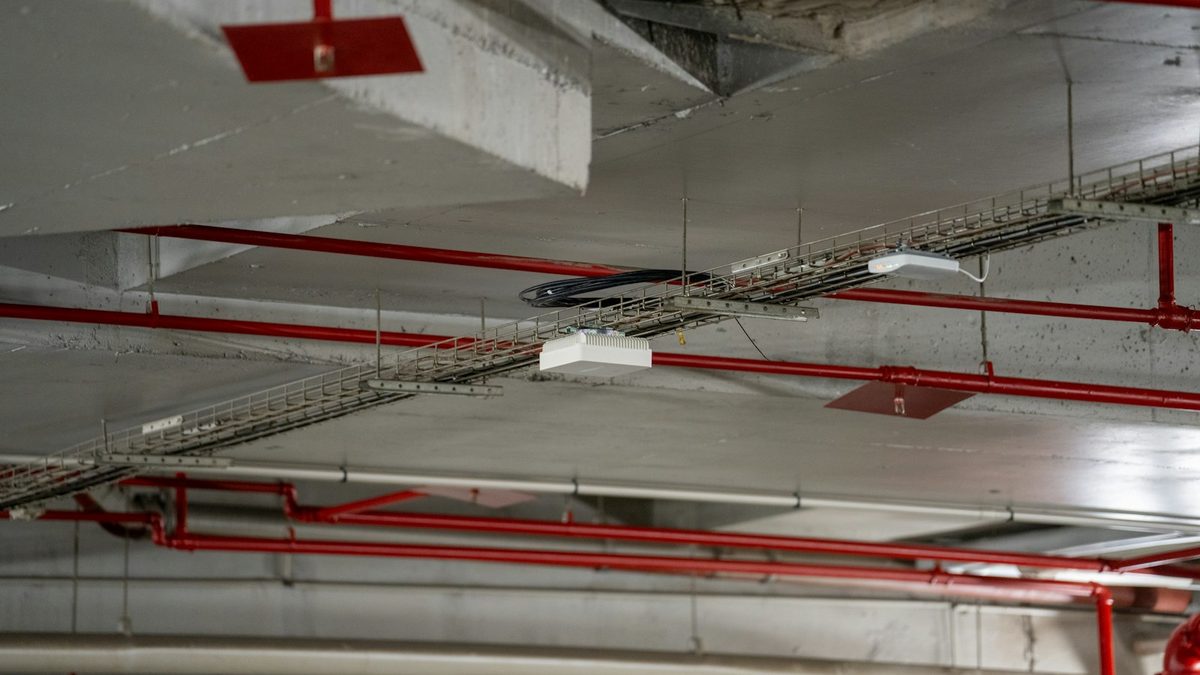
AI Autolocation 2.0 with Live Location. The release describes the underlying capability this way: “AI Autolocation works like GPS, but inside buildings where GPS does not operate, and it works without the need to install wireless hardware devices like bluetooth beacons.” The 2.0 version “takes it further, allowing users to understand their position in real time, all the time, powering entirely new field workflows.”
Site Mode. A mobile experience that “puts a user’s live location directly on project drawings and BIM models, even when offline, allowing users in the field to instantly access relevant information, open Field Notes and expedite issue workflows based on exactly where they are on the jobsite.”
AI Walk-and-Talk. Described as “a capability that allows users to create structured updates by speaking naturally as they move through the jobsite. The images and voice are tagged in real time to jobsite locations, providing a rich data set of site status.”
OpenSpace Track, expanded, plus a Track API. The company “has expanded its progress tracking offerings with new functionality for quantity tracking, markups and predictive analytics,” and “also announced its Track API, which allows customers to pull progress tracking data into whatever core system a customer uses — ERP, BI dashboards, or PM tools.”
The OpenSpace Agent Ecosystem — “an open, interoperable AI agent platform that understands what is happening on the jobsite, and can tackle work that teams have to do.”
The Argument Underneath
The line that explains the strategy comes from co-founder and CTO Michael Fleischman, and it is unusually direct about a limit in how construction AI is currently being sold:
“AI agents need eyes. An agent may be able to read every report associated with a project, and that provides real value. But without visual and spatial context, AI still cannot fully understand the scope of what drives business results for our customers – that data lies in the field.”
Analysis. That is a positioning claim aimed squarely at the document-centric agents the rest of the market has spent 2026 shipping. Most construction agents released this year read text: RFIs, submittals, specifications, daily logs, contracts. They are good at it because the corpus is already digital and already structured enough to parse. What they cannot do is establish whether the thing described in the document is true on site, because nothing in the text layer connects to the physical one.
OpenSpace’s answer is to treat visual capture as the grounding layer and rent it out — an agent ecosystem where other people’s agents consume OpenSpace’s spatial data rather than an attempt to build every agent itself. CEO and co-founder Jeevan Kalanithi frames the same point as a refusal: “Construction doesn’t need another disconnected tool or system that asks teams to manually input information into a form. The next phase of the industry will be defined by platforms that understand the physical world and make that intelligence available wherever teams already work.”
The Track API belongs to the same strategy. A progress-tracking product that pushes its output into a customer’s ERP or BI stack is competing to be a data source rather than a destination, which is a meaningfully different business from competing to be the system of record. It reads as a bet against the direction the platforms have taken: Procore agreed in July to pay roughly $845 million for DroneDeploy, bringing reality capture inside its own walls, and Buildots raised $130M for a platform it markets under its own category name, “construction intelligence.”
Which posture wins is not settled, and this newsroom has covered arguments on both sides. It is worth noting that OpenSpace’s own pitch includes an integration example: the customer quoted in the release, Zeeshan Haider, Director of Business Process at ISEC, Inc., is describing Autodesk data surfaced inside OpenSpace — “OpenSpace puts Autodesk Issues front and center with pinpoint accuracy so we can get them resolved faster. The faster we resolve issues, the greater benefit to the project.”
The Scale Claim
The release supports the data argument with four figures, which are the company’s own: imagery analysed from “more than 110,000 construction projects,” “over 77 billion square feet,” across “132 countries,” and “more than 500 million expert-verified labels and descriptions.” The square-footage and country figures also appear on OpenSpace’s homepage. On the customer side, the release’s boilerplate names three: “Customers like Suffolk, Comfort Systems, and Tishman Speyer rely on OpenSpace to gain critical insights from their sites, avoid destructive investigations, and finish projects ahead of schedule.”
The last of the four figures is the one that matters for the agent argument. Captured square footage is a measure of how much the cameras have seen; half a billion expert-verified labels is a claim about supervised training data, which is what makes a visual model useful to something downstream. We have not independently verified any of the four, and the release does not say what qualifies a label as expert-verified.
This is also not OpenSpace’s first time making scale the argument. The company passed 1,000 documented data center projects in June, half of them added in the preceding year.
Availability Is the Caveat, and the Company Says So
The release is explicit that much of what was shown is not shipping today. It uses “previewed,” “upcoming capabilities” and “in Early Access,” and closes by saying that “Additional information about upcoming feature availability, participation in Early Access and Beta programs, and general customer access will be shared in the coming months.”
What the release does claim as live is the programme behind it: “OpenSpace is already putting this vision into practice, working with a select group of Early Access customers to build and deploy AI agents against real-world construction workflows.” That is a statement that agents are being built with a defined group of customers, not that the ecosystem is open to anyone.
That is a customer-conference announcement doing what customer-conference announcements do, and the company is not hiding it. But it means the right way to read the Agent Ecosystem today is as a declared direction with an Early Access programme behind it, not as a live marketplace with third-party agents in it. This article does not treat any of the announced capabilities as generally available, because the release does not.
What Is Not Established Here
We scanned the release twice, in differently worded passes, for pricing terms and for availability dates. The words “price,” “pricing,” “cost,” “generally available” and “general availability” do not appear in it. The dating it does give is “in the coming months,” for feature availability, Early Access and Beta participation, and general customer access alike — so Site Mode, AI Walk-and-Talk, Live Location and the Track API have no published ship date.
The release does not name the members of the Early Access group or say how many there are, and it does not name any third-party agent or agent developer in the ecosystem. Suffolk, Comfort Systems and Tishman Speyer appear in the release’s boilerplate as OpenSpace customers generally, not as participants in any of the capabilities announced here, and this article does not connect them to one.
On AI Autolocation, the release says what the system behaves like and what it does not require — GPS-like indoors, no installed wireless hardware such as bluetooth beacons — rather than how it works. This article makes no claim about the underlying method.
The four scale figures are presented as company metrics without an independent source, and are reported here on that basis.
Sources
- OpenSpace, “OpenSpace Unveils the Next Generation of Its Visual Intelligence Platform at Waypoint 2026”, 10 September 2026 (also distributed via PR Newswire)
- OpenSpace’s website