Rebuild, which sells software to property restoration contractors, announced on 15 September that it had raised more than $13 million. The announcement names Asymmetric Capital Partners, Gutter Capital, 25madison, Lightbank and Green Egg Ventures as the investors, describing the company as “the AI operating system for the property restoration industry.”
The announcement does not attach a round letter to the raise — the only “Series A” in its text sits in Asymmetric’s boilerplate about the stages that firm invests at. Asymmetric Capital Partners does apply one in its own investment note, published the same day, saying it “led the Series A in Rebuild.” A notice from Orrick dated 16 September puts the figure at $13 million and describes the round as “led by Asymmetric Capital Partners, Gutter Capital, 25madison, Lightbank and Green Egg Ventures” — all five, rather than Asymmetric alone. Orrick is not a neutral observer here: the same notice says “Orrick advised Rebuild on the transaction.”
Why This Is a Construction Story
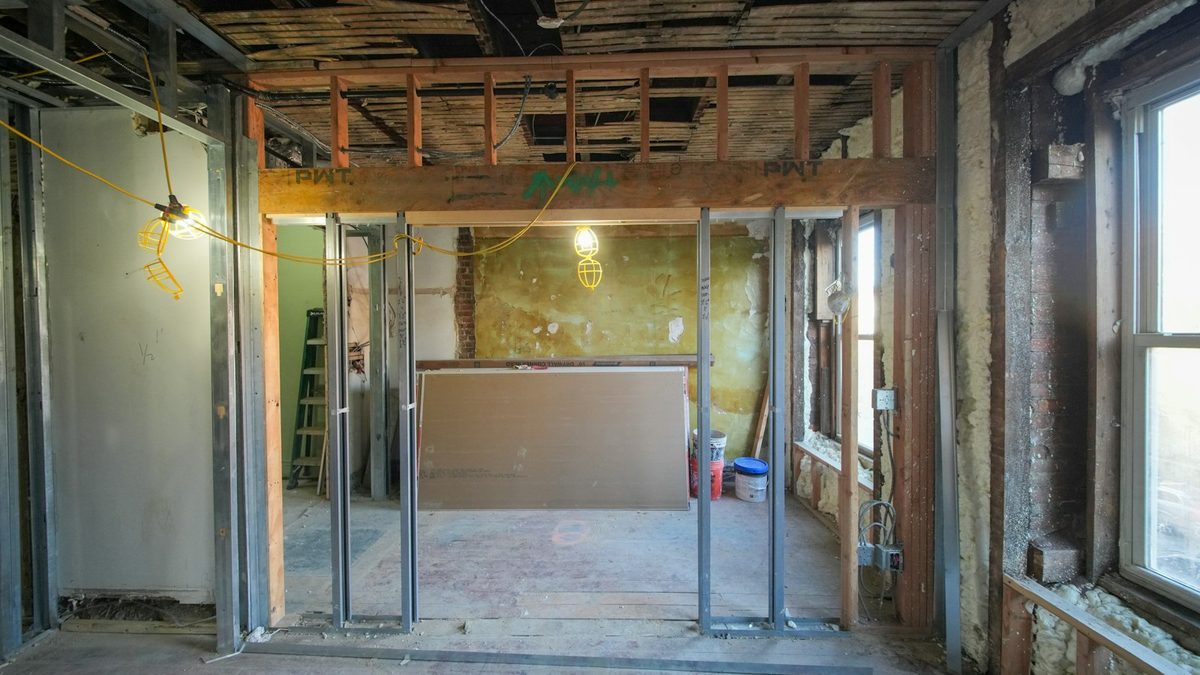
Restoration is the part of construction that nobody schedules. A pipe bursts, a roof fails, a fire runs through a floor of a building, and a contractor arrives to dry it out, tear out what is ruined and rebuild it. The work itself is demolition, framing, drywall, mechanical and finishes — ordinary construction trades, performed in an occupied building, on an emergency timetable, for a customer who is not actually paying the bill.
That last part is what makes the sector different, and it is where Rebuild has aimed. The person paying is an insurer, and the insurer pays against a line-item estimate that has to survive review. So the constraint on a restoration contractor’s revenue is not how fast its crews can work. It is how fast an estimator can produce a defensible document, and how much of what was actually done survives the adjuster’s pass.
Asymmetric’s note sizes the sector plainly: property restoration, it writes, “is a $100 billion business in the US.”
What the Company Says the Product Does
Rebuild’s pitch is that the estimate should be finished before the estimator leaves the building. The company’s site frames the product as software that “enables your team to write accurate, high-dollar value estimates in a fraction of the time,” and offers the same claim from the other direction — “Cut your cycle time in half and increase your revenue per job.” Asymmetric describes the same workflow in full: “Rebuild lets field estimators go paperless: what used to be a multi-day process of documenting storm and water damage now takes a few clicks before a compliant report goes out to a carrier like Chubb.”
The numbers in the announcement are the company’s own, and are reported here as the company reports them. Rebuild says its customers are “cutting claim cycle times by more than 50% while increasing reimbursements by over 10%,” and that the business has “grown revenue nearly 5x over the past year.” The company’s site separately says customers “see a 12% revenue increase on average.” We found no independent audit of these figures, and no methodology or sample is given in any of the four documents cited below.
On adoption, the announcement’s wording is careful and worth reproducing exactly: Rebuild “is now used by operators across some of the largest restoration networks in the country, including Servpro, ServiceMaster, and Belfor.” That is a claim about individual operators inside those franchise networks — not a claim that the three brands have signed as corporate customers. Asymmetric’s note goes slightly further, describing “named accounts at ServiceMaster, Belfor, ServPro, PuroClean, and Core”; that is the investor’s characterisation rather than the company’s. Rebuild’s own site names three smaller customers directly — Titan Restoration, Revive Restoration and TWM Water Restoration — with each quoted by an owner or COO.
The Founder Built It On His Father’s Business
The origin story is unusually concrete, and the company tells it without hedging. Founder and CEO Alex Toporek “grew up around his father’s restoration business in the Northeast and saw firsthand how much time experienced operators lost to paperwork, estimating, and insurance administration — time that ultimately delayed recovery for homeowners,” the announcement says. “Toporek initially built Rebuild to solve those problems inside the family business. Since adopting the technology, the company has reduced its own claim cycle times by more than 70%.”
That is a founder whose earliest deployment was his own father’s company, and whose headline internal metric comes from it. It is a strong signal about product fit and a small sample at the same time; the announcement presents it as both.
Asymmetric’s note adds that Toporek “built his commercial instincts at 25madison and DoorDash,” and that “Co-founder John Reim and Head of Engineering Jack Walters spent their careers at Block, Zillow, and Meta.”
One relationship in the cap table is worth stating plainly rather than leaving for a reader to find: 25madison, listed among the investors, is also where Asymmetric says Toporek previously worked. Grant Silow of 25madison describes his involvement in the announcement in terms that match: “I joined Alex for the first customer conversations, early in Rebuild’s ideation phase. It was obvious from the get-go that an AI-native solution would be a game-changer for the industry, and that Alex was the perfect founder to build it.”
What the Investors Are Betting On
Two of the investor quotes in the announcement are doing different jobs. Rob Biederman of Asymmetric makes the unit-economics argument: “This product creates unparalleled value for its customers, on the order of 50 to 100x ROI.” That is an investor’s estimate of customer return, not an audited figure, and it is presented in the announcement without a methodology.
Dan Teran of Gutter Capital makes the market-timing argument, and it is the more interesting of the two because it stacks three separate bets: “Rebuild stands at the intersection of three macro trends; the restoration industry is undergoing generational transformation, extreme weather events are on the rise, and AI unlocks the potential for software to actually do work for SMBs. These three factors made Rebuild a standout opportunity for Gutter.”
Analysis. Strip the framing and the thesis is a straightforward one about where AI margin actually sits in construction. The segments that have drawn the bulk of contech capital — general contracting, preconstruction, design — largely spend their software budget on coordination. Restoration spends it on documentation, because documentation is directly convertible into revenue: a better-evidenced estimate is a larger cheque, and a faster estimate is a shorter cash-conversion cycle. A tool that shortens the gap between the walkthrough and the approved scope is selling a working-capital improvement, not a productivity improvement, and small contractors buy those more readily.
Cutting the other way is distribution. A market served largely by small franchise operators is a long, expensive sales motion for enterprise software, which is one plausible reason restoration has drawn less contech capital than its size would suggest — and it is a natural motion for a product that can be sold to a single operator on the strength of one job.
What Is Not Established Here
The size of the round is given two ways: “more than $13 million” by the company, “$13 million” by Orrick. On the round’s name, the announcement text as carried by Restoration & Remediation uses no round letter; Asymmetric, which led it, calls it a Series A, and this article follows that characterisation while naming its source.
None of the four documents cited below gives a total-capital-raised figure, but the record is not silent. A Form D filed with the SEC on 29 January 2025 by Rebuild Technology, Inc. of New York records a total offering amount of $2,399,999, of which $2,094,999 had been sold to six investors, with a first sale date of 14 January 2025. That is an earlier raise, reported at the time by AlleyWatch. This article does not add the two figures together: a Form D records one offering, not a company’s lifetime funding, and no cumulative total has been published that we could find.
We did not find a valuation for Rebuild in the company’s announcement, Asymmetric’s note, Orrick’s notice, the SEC filing or in search.
Headcount, absolute customer count and absolute revenue do not appear in any of the four documents cited below. The “nearly 5x” growth figure is a multiple without a stated base, which is how the company has chosen to disclose it.
Sources
- Rebuild’s funding announcement as published by Restoration & Remediation, 15 September 2026
- Asymmetric Capital Partners’ investment note, 15 September 2026
- Orrick’s transaction notice, 16 September 2026
- Rebuild’s website
- Rebuild Technology, Inc., SEC Form D, filed 29 January 2025