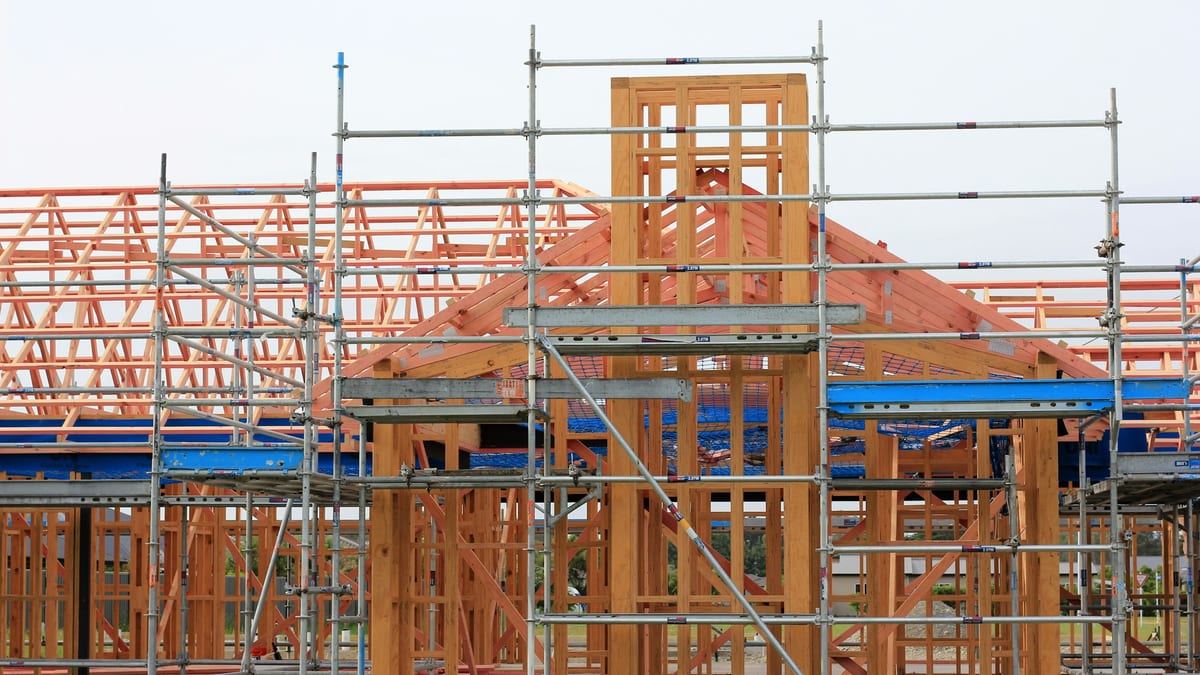

PataBid, an Alberta company selling AI estimating software to specialty sub-trade contractors, has raised $2 million in pre-seed funding led by Graphite Ventures. The company’s own announcement is dated 20 October and names Sprout Fund, Bluesky Equities, Inverted Ventures and “previous angel investors” as participants. Trade outlets carried the news from 19 October — Electrical Business and Electrical Industry News Week both report the same figures.
Two million dollars is a small round, and the interesting thing about it is how late it arrives.
Nine Years, and This Is the First Venture Cheque
PataBid’s own history page tells a story that is unusual in a sector where seed rounds often precede a shipping product. It dates the company’s origin to 2017, when Melvin Newman — then a chief estimator at a national subcontracting company — built himself a tool to monitor public tender sites. He showed it to a college friend, Paul Burris, and the two founded PataBid around it. That first product, PataBid Tenders, still exists.
The estimating product came later and slowly. The page says the first lines of Quantify were written in October 2019 and that it “finally launched” in March 2022. Newman and Burris left their day jobs that same year. Licence sales were then halted for six months to fix bugs before resuming in the autumn of 2022.
And on the funding, the page is blunt: “Being a bootstrapped company without venture capitalist funding means facing a challenging and lengthy journey, but it’s not impossible!” That narrative runs only to the first quarter of 2024, so it describes the company as it was then rather than today — but taken with a round the company itself labels pre-seed, it puts this $2 million as PataBid’s first venture round, nine years after founding and more than four years after Quantify went on sale. The announcement names its earlier backers only as “previous angel investors” and does not quantify them.
So how did it fund nine years? Partly on non-dilutive public money. In a case study published by Thin Air Labs on 29 May 2026, PataBid’s director of sales and marketing, Emily Newman, is quoted saying: “We only have one private investor, and we’ve chosen to take this bootstrapped path.” The grants, she says, “allow us to hire, expand, and invest in our product without giving up equity.” The same page says Thin Air Labs helped PataBid secure a $71,000 IRAP grant for AI development, with a second in progress and an SR&ED claim prepared, on top of provincial funding the company already had.
That is the sequencing worth noting: a shipping product and paying customers, supported by grant money and a private investor, before any venture round. Whether that reflects discipline or constraint is not something the announcement answers, and we are not going to guess.
What Quantify Does
Per the announcement, Quantify is a cloud-native estimating platform meant to take drawings to a priced estimate “in hours instead of days.” Symbol recognition and natural-language processing handle takeoff; direct supplier integrations supply real-time pricing; contractors can order materials inside the tool. PataBid’s website adds a PDF editor, costing, proposal generation and closeout, and says the AI works by having the estimator select one item on a drawing and set its attributes before the software finds the rest.
The company’s figures, reported as the company’s: more than 200 contractors use Quantify, and more than $2 billion in bid value has been processed through it. It says the product is sold to electrical, mechanical, plumbing and fire-protection contractors in Canada and the US, with licences starting at $2,460 a year. PataBid puts its addressable market at more than 463,000 complex subtrade contractors across North America. We report these as the company’s own numbers and have not independently verified them.
The trade focus is worth noting against the rest of this field. Most of the AI estimating money we have covered recently has gone to tools aimed at a broader buyer than the specialty sub-trade — Berlin’s Kuro raised €10M on bid evaluation for tier-one DACH contractors, Quotr took $4M on the bids contractors never submit, and Constrik raised €350,000 for Spanish builders’ estimating departments. PataBid is selling to the subcontractor doing a conduit count, which is a narrower buyer and a more countable drawing.
Newton, the Part That Does Not Ship Until 2027
The second product in the announcement is Newton, described as a conversational estimating agent that lets estimators query drawings and specifications in natural language, flag pre-bid risks and run what-if scenarios on material and labour changes. It is in beta with selected customers, with commercial launch planned for 2027.
A 2027 date on an agent announced in 2026 is the detail the round explains. In a post dated 29 April 2026, PataBid said it had been selected for the inaugural cohort of the TELUS Sovereign AI Accelerator, and that the programme would speed Newton’s development while keeping customer data, model training and IP in Canada.
That cohort checks out independently. L-SPARK’s release, dated 28 April 2026, names five companies — Airy3D, Codalio, Edge Signal, PataBid and TopoLift — and describes PataBid as offering “AI enterprise-grade construction bidding software designed for complex specialty trades, delivering standardization and risk reduction for commercial, industrial, and institutional projects.” The programme runs six months and gives participants compute credits on the TELUS Sovereign AI Factory plus advisory support, with participants retaining control of their data and IP.
So the shape of the thing is: a bootstrapped estimating vendor got subsidised sovereign compute in April, raised its first venture round in October, and has an agent in beta it does not intend to sell for another year. The money is buying the gap between those two dates.
Estimating Is Where Contractors Say They Expect AI to Land
There is good third-party evidence that PataBid is pointed at the right function, and it is more specific than the usual adoption survey.
The 2026 Workforce Survey from the Associated General Contractors of America and NCCER drew 1,830 total responses. One question asks which areas respondents believe AI will have the greatest impact on within their own company over the next five years, allowing up to three selections; it drew 749 responses and ranks twelve functions. Estimating and bidding leads at 67%, ahead of document and contract review (66%), scheduling and planning (62%), project management (49%) and accounting and finance (39%). At the other end, safety management is sixth at 26% and field operations last at 10%. (The response counts and the full twelve-item ranking are in the survey’s national results tables rather than the analysis document.)
The same survey finds 51% of respondents expecting AI and robotics to have a somewhat or very positive impact on the industry over the next five years, against 8% expecting a negative one and 21% calling it mixed. That question drew 775 responses rather than the full 1,830, so it is a subset of the panel. And 42% of respondents said shortages of their own or their subcontractors’ workers had delayed projects — the most commonly cited cause of delay in the survey, down from 45% a year earlier.
Read together, those numbers are a reasonable argument for why estimating software is where the sector’s AI money keeps going: it is the function contractors themselves rank first, and it is an office function that does not require anyone to be on site. That reading is our analysis, not a finding of the survey.
What the Announcement Does Not Say
PataBid’s announcement gives no valuation, and we found none in the trade coverage we read. It gives no total raised, and describes the earlier money only as angel investment without an amount. It does not state whether the $2 million is Canadian or US dollars, and neither does any of the coverage we checked — so we have left the figure as every source has it.
Graphite Ventures is a Canadian seed-stage firm; its own site lists Toronto as its address alongside offices including Calgary and Edmonton, and its team page lists Adrian S. Mitchell as a Principal based in Calgary. Mitchell is the Graphite voice in the announcement, quoted saying PataBid “has built something contractors genuinely need” and that “Melvin and his team bring decades of industry knowledge to estimating, one of construction’s most outdated processes.”
For scale on the lead: BetaKit reported in August 2023 that Graphite closed Fund IV at $110 million CAD, wrote early-stage cheques of $250,000 to $1 million, and had a principal in Calgary covering Alberta and Western Canada. Those details are three years old and describe the fund at that close, not necessarily today — but a $2 million round led out of Calgary into an Alberta company sits squarely inside the mandate that article describes.
Newman’s own line in the announcement is narrower than the market figure above it: “We see PataBid’s future in revolutionizing how the industry estimates complex plumbing and electrical work.” On the evidence of the last month — and of two takeoff benchmarks that disagree about how good frontier models are, and agree only that they trail human estimators — the narrower claim is the more defensible one.